James Spiers, Marlee Trandel-Hayse, and Lucas Speer, Department of Horticulture, Auburn University
Introduction
Identifying blueberry cultivars that are best suited for particular regions of the southeast US is a critical need. The performance of early-ripening blueberry cultivars in open field and high tunnel cultivation was evaluated to determine feasibility of expanding blueberry marketing windows. Spring frost is the most limiting factor for production of blueberries in central Alabama. Many stakeholders are excited about the new releases of southern highbush blueberries with enhanced fruit quality and production traits. However, many of these are not recommended for Alabama because of their susceptibility to spring frost. High tunnels can potentially be used to protect and enhance early-ripening blueberry cultivars. This project determined the yield and fruit quality of early-ripening blueberry cultivars in these two systems.
Materials and Methods
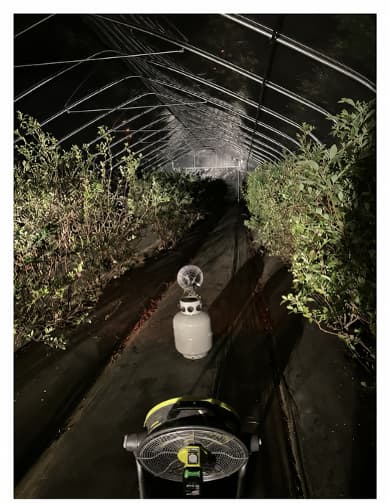
Research plots in Tallassee, AL, were prepared to have suitable soil pH (~4.8) and amended with pine bark in January 2022. Raised beds were amended with an additional 4 cm (2.5 inch) of pine bark and covered with black landscape fabric. Blueberry plants were planted in March 2022. Plants used in this study were one-year-old 2.84 L (1 trade gal) southern highbush blueberry (Vaccinium corymbosum L. interspecific hybrids) cultivars ‘Arcadia’, ‘Avanti’, ‘Chickadee’, ‘Farthing’, ‘Gumbo’, ‘Indigocrisp’, ‘Keecrisp’, ‘Legacy’, ‘Meadowlark’, ‘New Hanover’, and ‘Optimus’ (Island Grove Ag Products, Winter Haven, FL), and two rabbiteye blueberry (Vaccinium virgatum) cultivars, ‘Krewer’ and ‘Titan’ (Bottoms Nursery, Concord, GA). Southern highbush cultivars ‘Bluecrisp’ and ‘Colossus’ (Island Grove Ag Products, Winter Haven, FL) were also planted in this study but were younger plants and much smaller in size in comparison to the one-year-old southern highbush and rabbiteye cultivars. We established two studies, open field and high tunnel. Both field and high tunnel plots were planted in a randomized complete block design with eight blocks. The high tunnels were 9.1 m wide, 29.3 m long, and 4.3 m high. There were fifteen cultivars (thirteen southern highbush cultivars and two rabbiteye cultivars) with one single-plant replication per block. Both field and high tunnel contained 120 plants each, totaling 240 plants. During potentially damaging freeze events, propane heaters (2) and fans (2) were utilized in the high tunnel (Fig. 1).
Results and Discussion
We collected two years (2022 – 2023) of data on growth and establishment, environmental data, and preliminary yield data in 2023. Bloom and harvest times were expedited in high tunnel conditions. Plant growth was greater in the field in the first year, and greater overall in the high tunnel by the end of the second year.
Maximum air temperatures were greater in the high tunnel compared to the field. However, minimum temperatures were similar in the high tunnel compared to the field during freeze events. The high tunnel was not effective enough during a freeze event experienced on March 15, 2023, to provide adequate protection from frost injury, so we incorporated two portable propane heaters within the high tunnel for a subsequent freeze event on March 20, 2023. These provided adequate protection and were utilized for all future freeze events with the addition of a portable air-circulating fan behind each heater in 2025 (Fig. 1).
Bloom and harvest times were earlier in high tunnel conditions. The high tunnel had higher air and soil temperatures overall (0.2-1.0 °C = 0.4-1.8 °F), and less photosynthetic active radiation. Though we expected to experience spring frost injury on the early-ripening cultivars in the field, we did not experience severe spring frost injury in the second and third year (2024 – 2025) of yield data collection. Hence, we were able to determine differences between the two production systems in the absence of observed cold injury. Yields were greater overall in the high tunnel for both years, with ~30% greater yield in high tunnel for 2024 and ~15% greater in 2025 (Table 1). ‘Arcadia’, ‘Avanti’, ‘Chickadee’, ‘Indigocrisp’, ‘Meadowlark’, and ‘Optimus’ had substantial yields in April in high tunnel conditions in both years, while peak production occurred in May for these cultivars in the field (very low yield, if any in April). ‘Krewer’, ‘Gumbo’, ‘Avanti’, and ‘Optimus’ had among the greatest yields in the high tunnel in 2024. ‘Optimus’, ‘Gumbo’, ‘Indigocrisp’, ‘Arcadia’, and ‘Krewer’ had the greatest yields in 2025 inside the high tunnel. ‘Gumbo’, ‘New Hanover’, ‘Optimus’, and ‘Arcadia’ had among the greatest yields in the field in 2024. ‘Gumbo’, ‘Krewer’, ‘New Hanover’, ‘Legacy’, and ‘Arcadia’ experienced the greatest yields in 2025 in the field location. Berry weight was greater overall under high tunnel conditions for both years for almost all cultivars. Soluble solids content (soluble sugars) was similar under the two environmental conditions.
Summary
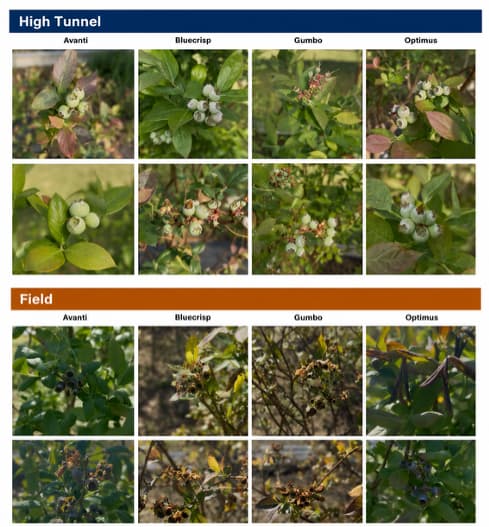
In summary, high tunnel cultivation of early-ripening blueberries provides many advantages. Protection from cold injury with the addition of heaters and fans inside the tunnel is a big advantage. Though cold injury was not severe during the 2024 and 2025 growing seasons, spring frost injury should be expected for many of the early-ripening cultivars and was experienced in the 2026 season (Fig. 2). Protection from rainfall enhances fruit quality, as few split berries were observed under the high tunnel when compared to the field. The enhanced heat provided by the high tunnel allows for increased growth and expedites flower and fruit development, for earlier and greater yields. Heat stress in the summertime was a concern for this study but was not realized. We did keep the high tunnel sides open throughout the year and only closed during freezing events. Growers could close sides during winter months to potentially speed up production. Many of the cultivars used in this study are of very high quality and would make great additions to our current rabbiteye blueberry cultivars in production. Though harvest is quite early for ‘Optimus’ and ‘Arcadia’, the yields were great for both high tunnel and field in the absence of spring frost conditions during the two years of this study. The later-blooming cultivars tended to perform best in the field, even in the absence of severe spring frost injury. Of these, ‘Gumbo’ appears to be the best choice for field production to obtain good yields in May. ‘Indigocrisp’, ‘Keecrisp’, and ‘Bluecrisp’ have a firm and “crunchy” texture that is attractive to growers and consumers. Likely well-suited for mechanical harvest and postharvest longevity. They both performed quite well in the high tunnel, but also at or above average in field conditions.
The big question of whether high tunnels are economical depends on the market and scale. High tunnels have significant upfront costs. However, they provide the insurance of saving your crop consistently compared to other strategies. In addition, you can get greater yields, larger sized fruit, fewer culls due to split berries and other fruit rot issues that come with rainfall, and earlier fruiting.
Figures and Tables
Table 1. Estimated season-total yield (g per plant) of 15 southern highbush blueberry cultivars grown in field and high tunnel production systems during the 2024 and 2025 seasons. Cell values are least-squares means from a per-cultivar PROC GLIMMIX two-way (Year × Location) model fit to plant-level season totals (n = 8 plants per cell). Bold values within each year indicate the higher-yielding location. Type III p-values are from the per-cultivar mixed model.
| Cultivar | 2024 Field | 2024 High Tunnel | 2025 Field | 2025 High Tunnel | Type III p-value for Year | Type III p-value for Location | Type III p-value for Year × Loc |
|---|---|---|---|---|---|---|---|
| Gumbo | 2,727 | 3,362 | 3,975 | 4,222 | 0.0121 * | 0.2715 NS | 0.6250 NS |
| Optimus | 2,255 | 3,508 | 3,329 | 5,054 | 0.0004 *** | <0.0001 *** | 0.4723 NS |
| Krewer | 988 | 3,300 | 4,503 | 4,030 | <0.0001 *** | 0.0274 * | 0.0015 ** |
| Arcadia | 2,698 | 2,019 | 3,763 | 3,724 | 0.0031 ** | 0.4100 NS | 0.4615 NS |
| New Hanover | 2,393 | 2,525 | 4,253 | 2,969 | 0.0008 *** | 0.0707 † | 0.0284 * |
| Indigocrisp | 1,941 | 2,260 | 2,417 | 3,812 | 0.0288 * | 0.0614 † | 0.2320 NS |
| Keecrisp | 1,937 | 3,024 | 2,092 | 3,358 | 0.5890 NS | 0.0137 * | 0.8434 NS |
| Avanti | 1,758 | 3,112 | 2,214 | 2,344 | 0.7753 NS | 0.1820 NS | 0.2685 NS |
| Legacy | 1,241 | 1,646 | 3,693 | 2,788 | <0.0001 *** | 0.3801 NS | 0.0267 * |
| Titan | 615 | 1,874 | 2,023 | 2,976 | 0.0002 *** | 0.0007 *** | 0.5997 NS |
| Meadowlark | 923 | 1,458 | 1,859 | 2,745 | 0.0034 ** | 0.0500 † | 0.6171 NS |
| Chickadee | 1,512 | 2,164 | 1,085 | 1,488 | 0.0100 * | 0.0133 * | 0.5402 NS |
| Bluecrisp | 757 | 1,449 | 1,582 | 2,090 | 0.0325 * | 0.0762 † | 0.7786 NS |
| Farthing | 1,153 | 1,424 | 743 | 1,936 | 0.8780 NS | 0.0347 * | 0.1733 NS |
| Colossus | 460 | 161 | 791 | 556 | 0.0223 * | 0.0862 † | 0.8329 NS |
← Scroll to view additional columns →
Significance codes for p-values: *** p < 0.001; ** p < 0.01; * p < 0.05; † p < 0.10; NS p ≥ 0.10. Cultivars are ordered by mean of the four cells (descending).