Penelope Perkins-Veazie, Professor, Postharvest Physiology, North Carolina State University
Refractometers have been used extensively in the field and in wine/juice preparation to easily check soluble sugars/total soluble solids in produce or liquids. The original refractometers depended on the ability to see a calibrated scale using ambient or built-in light. Refractometers measure the bend (refraction) of a light beam as it moves through a liquid sample placed on a glass prism. Total soluble solids (TSS) include the soluble sugars (usually 70-80% of a fruit liquid) as well as anything else that is dissolved in that liquid, such as organic and amino acids, minerals, and phenolic compounds. TSS differs from °Brix, which is the actual sugar value (1°Brix is equal to 1 gram of sucrose in 100 grams water). While less precise than specific sugar identification (which is generally done by chromatography), refractometers provide a very rapid and simple estimation of the soluble sugars (usually fructose, glucose, and/or sucrose) in many fruits and fruiting vegetables. Most ripe fruits have a soluble sugars readings (°Brix or percent) of 4 to 25% while juice concentrates and jellies can be 50 to 65%. General use refractometers can detect soluble sugars/TSS in the 1 to 50% range.
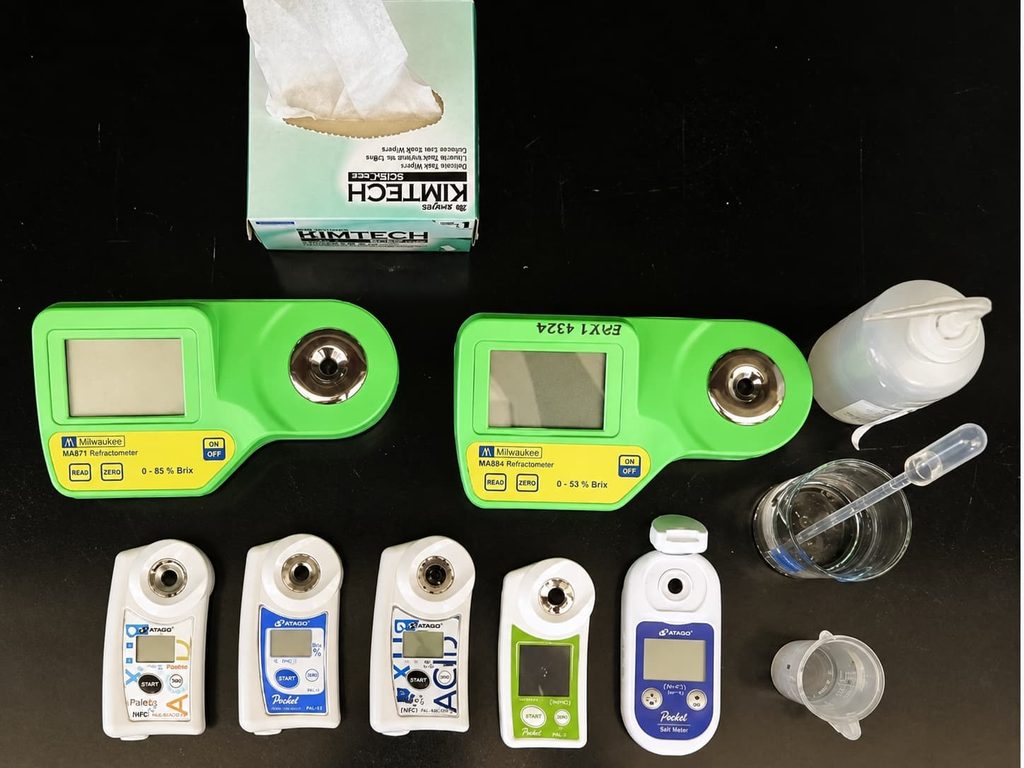
The introduction of digital palette or pocket-sized digital refractometers offer a portable and eyesight-saving option for evaluation of fruit quality and maturity. These tools also offer a fun and visual way for teachers to demonstrate refraction concepts, STEM training in replication, and biological changes in produce ripeness.
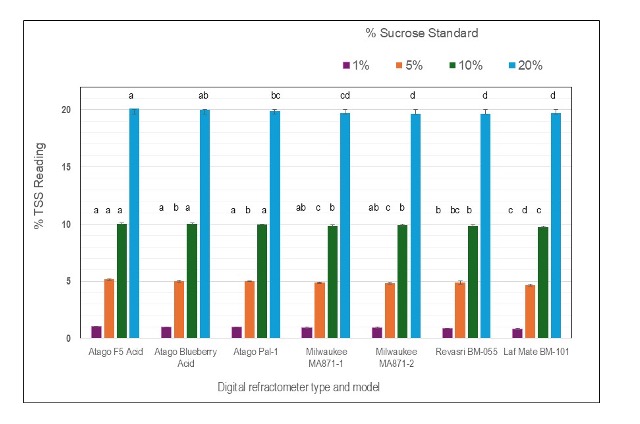
We purchased several refractometer versions online (Table 1) and compared their accuracy using sucrose (table sugar) solutions of 1, 5, 10, and 20% (Figure 1). These solutions were made by weighing 1, 5, 10, or 20 g of sugar (using an inexpensive portable jeweler’s scale), adding the sugar to containers (disposable cups) with 100 ml or g of distilled water, and stirring well until dissolved. The refractometer was calibrated by adding a few drops of distilled water to the well, pressing start, and zeroing out the refractometer if necessary. After wiping dry, a few drops (0.5 to 1 ml or ¼ teaspoon) of the sugar solution were added to the well. The refractometer was started and the result recorded. Note that Kimwipes, optical lens tissues, or microfiber cloths should be used to remove juice and clean the surface. Don’t use paper towels as these will scratch the prism.
| Brand | Model | Source | Price ($) |
| Atago | F5 acid | Atago US | 1200 |
| Atago | Blueberry acid | Atago US | 1000 |
| Atago | Pocket Pal-1 | Atago US | 370 |
| Milwaukee | Palette-style MA871 (1) | Amazon | 135 |
| Milwaukee | Palette-style MA871 (2) | Amazon | 135 |
| Revasri | BM-055 | Amazon | 15 |
| LAFmate | BM-101 | Amazon | 35 |
We made each sucrose solution three separate times and tested the solutions three times using each refractometer, for a total of nine tests of each sucrose concentration. Solution temperature was 21.7 °C (71 °F). If a refractometer lacks temperature compensation, a sucrose solution is most accurate at 20 °C (68 °F). All units tested here have temperature compensation included.
Overall, most of the units were within 2-5% of the correct sucrose concentration. (The degree of error tends to decrease as sugar increases.) The Atago acid meters and Pocket Pal were most consistent and accurate. However, the performance of the very inexpensive ($15) Revasri was quite close, and it offers an affordable option for those who take soluble sugar readings infrequently. The Milwaukee brand (palette style) refractometer also performed well.
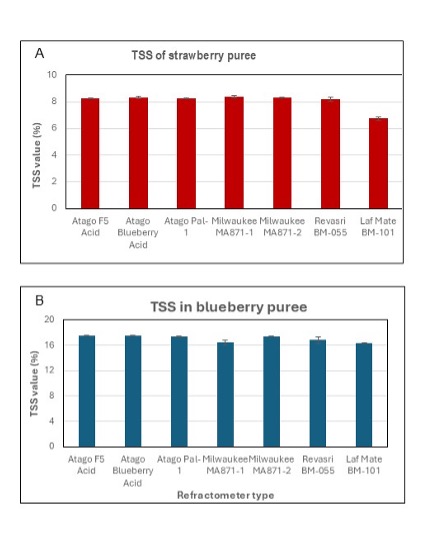
A slightly different picture occurred when purees of strawberry and blueberry were used on the refractometers. For this, we pureed 10 strawberry fruits and 30 blueberries and measured each three times on each refractometer. Despite setting each refractometer to 0 with distilled water, and using sucrose solution checks, there was more variation than expected with the fruit purees.
Overall, the strawberry purees were about 8% and the blueberry purees about 17% TSS. The Atago brand refractometers gave similar readings for both strawberry and blueberry purees (Figure 3A, B). The LAFmate brand produced a reading about 1% lower in TSS values for the strawberry and blueberry purees, compared to those from the other brands. One of the Milwaukee and the Revasri brand had readings 0.6 to 1% lower in TSS values for the blueberry puree than the Atago brands.
In summary, numerous digital refractometers are available, across a wide range of prices. While the higher priced units may perform more consistently with different solutions and juices, it is possible to adequately measure TSS with inexpensive refractometers. If uncertain about the accuracy of a unit, testing the refractometer with a simple table sugar solution is recommended prior to the start of the fruit season.
Here are a few best practices to remember when using any refractometer:
- The refractometers in this study have built-in temperature compensation, covering 50 to 100° F. However, if your fruit is warm or cold, wait a few minutes for the expressed juice or puree to equilibrate before placing it on the refractometer prism.
- Try to use juice without much sediment, especially if squeezing fruit directly onto the sample well. Large amounts of fruit lumps can inflate the sugar reading or give an error reading.
- Make sure the well/prism is well rinsed with water when done to avoid etching of the prism with the acids in the fruit juices.
- Avoid using fruit or solutions with sand in or on them as that can scratch the prism.