Marcus Vinicius Marin, Natalia Peres
University of Florida, Gulf Coast Research and Education Center
Neopestalotiopsis continues to be one of the most challenging diseases facing strawberry growers. Since serious outbreaks were first observed in 2017, University of Florida researchers have been working to understand where the pathogen comes from, how long it survives, which cultivars are most at risk, and how cultural practices and fungicides can reduce losses. We now know that two genetically distinct lineages (genetic groups) of aggressive strains are associated with disease outbreaks in strawberry. Our research is continuing to determine whether these lineages differ in their behavior, epidemiology, or other characteristics important for disease development. So far, however, management recommendations remain the same for both lineages. One thing has become clear: there is no single solution. Successful management requires combining clean plants, early diagnosis, sanitation, cultivar selection, and well-timed fungicide applications.
A Disease with Many Faces
Neopestalotiopsis can cause leaf spots, leaf blight, fruit rot, crown discoloration, root symptoms, and plant collapse. Because these symptoms can be confused with other strawberry diseases, visual diagnosis alone is not always reliable. When in doubt, growers should submit suspicious plants for diagnosis.
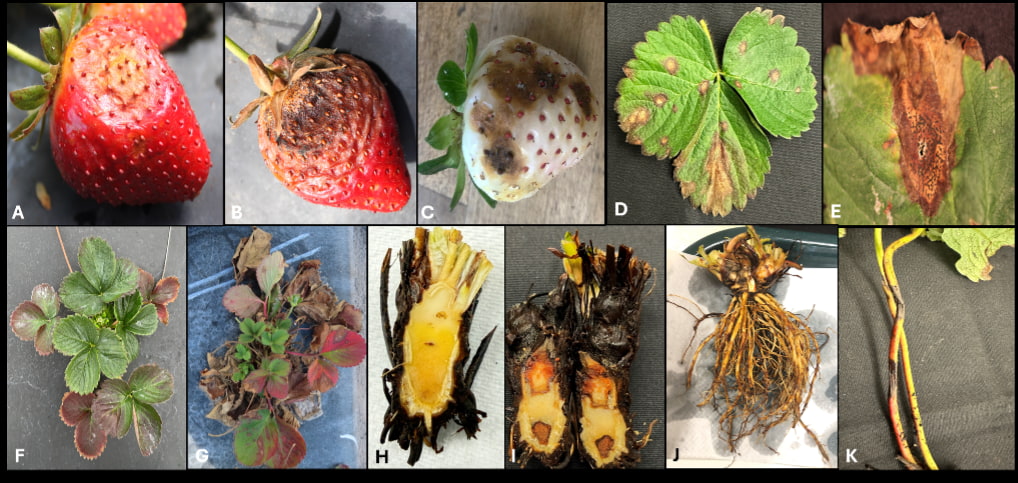
Samples can be submitted to a local plant diagnostic clinic, and UF/IFAS and the Gulf Coast Research and Education Center (GCREC) Plant Diagnostic Clinic remain available to support growers and diagnostic laboratories when additional assistance or confirmation is needed. We offer rapid diagnostic services for Neopestalotiopsis, combining traditional isolation with molecular diagnostic tools. Preliminary results are generally provided within 24-48 hours, helping growers make timely management decisions. The Clinic also has molecular tools to distinguish the major Neopestalotiopsis lineages currently affecting strawberry production.
Where Is the Disease Coming From?
Early Florida outbreaks were strongly associated with infected strawberry transplants originating from nurseries. However, infected transplants are not the only concern. The pathogen can survive in infected strawberry debris, especially on remaining crowns, for more than 17 months (in Florida), meaning inoculum left after an outbreak may contribute to initiating disease in the following season.
Surveys of cover crops commonly grown in Florida as potential alternative hosts showed that the evaluated crops (sunn hemp, Iron and Clay cowpeas, sorghum sudangrass, oats, sunflower, and ryegrass) were unlikely to represent an important source of inoculum for Neopestalotiopsis.
Be Prepared for a Potentially Wetter Winter
Weather conditions strongly influence disease development and spread. Prolonged periods of leaf wetness (>24 hours) favor disease development, while wind-driven rainstorms can facilitate the spread of inoculum within and between fields.
Weather deserves particular attention during the upcoming strawberry season. El Niño conditions could bring a wetter winter. Growers should scout fields regularly, especially following extended wet periods, and should not assume that every leaf spot, fruit rot, or declining plant is caused by Neopestalotiopsis. Early and accurate diagnosis is critical for choosing the appropriate management strategy.
Should Diseased Leaves be Removed?
Removing diseased leaves can reduce inoculum, but our trials showed an important tradeoff: aggressive leaf removal can reduce disease while also reducing yield.
Aggressively removing symptomatic leaves without fungicide applications significantly reduced Neopestalotiopsis fruit rot compared with the nontreated control (no leaf removal). However, yield remained low compared to weekly fungicide applications without leaf removal.
Thus, the loss of productive foliage and the labor required for intensive leaf removal should be considered. Our trial was conducted using a highly susceptible cultivar. Additional studies are needed to determine whether similar trends occur in cultivars with better tolerance to Neopestalotiopsis.
Cultivar Choice Can Reduce Risk
Not all strawberry cultivars respond the same way to Neopestalotiopsis. Experiments conducted in Florida classified cultivars as highly susceptible (Sweet Sensation® Florida127, Florida Brilliance) and moderately susceptible (Florida Ember® FL 20.80-4, Florida Encore® FL 20.34-183, Florida PearlTM FL 16.78-109). An experiment conducted in North Carolina (Heagy et al. 2025) classified cultivars as highly susceptible (Albion, Miss Jo, and Ruby June), moderately susceptible (Chandler, Camarosa, Fronteras, Ashley Jay, and Monterey), and least susceptible (Victor, Liz, Rocco, and Rutgers Scarlet).
Even a modest level of resistance can have a major impact on Neopestalotiopsis development, particularly when weather conditions are less favorable for disease. In Florida experiments, several inoculum concentrations were tested on Sweet Sensation® Florida127, a highly susceptible cultivar, and Florida Pearl™ FL 16.78-109, a moderately susceptible cultivar. During relatively dry seasons, symptoms developed on Sensation as early as one week after inoculation, while symptoms on Florida Pearl were delayed for approximately two months, even at the highest inoculum concentration of 10,000 spores/mL. This delay can have important consequences for disease epidemiology by slowing subsequent infection cycles, inoculum buildup, and disease pressure throughout the season. Overall, disease developed faster as inoculum increased, but the response was strongly influenced by cultivar susceptibility and weather conditions, highlighting the potential benefit of even moderate levels of resistance since we can’t control weather conditions. Follow up trials showed that the recently released Florida Ember had a response similar to moderately susceptible Florida Pearl.
Growers with a history of Neopestalotiopsis should consider spreading risk by planting at least some acreage with less susceptible cultivars. In the long term, breeding more tolerant cultivars will likely provide the most sustainable solution for this disease.
Fungicides: Product Choice and Timing Matter
Fungicides remain an important part of Neopestalotiopsis management, particularly during highly favorable weather. Among effective products registered for fruit growers in our trials were Thiram (FRAC M3), Switch (fludioxonil + cyprodinil; FRAC 12 + 9), and some DMI fungicides (FRAC 3), including Rhyme (flutriafol) and Inspire (difenoconazole). For nursery production, effective products include chlorothalonil, thiram, captan, and Omega (fluazinam), although registration status varies by location.
Timing is just as important as product selection. Because disease development is strongly influenced by environmental conditions, weather-based models are being evaluated to identify periods of higher disease risk. The goal is to place the few effective products during the periods of higher disease risk.
As a reminder, growers should always follow current pesticide labels, including application rates, preharvest intervals, maximum seasonal applications, and resistance-management restrictions.
Putting It All Together
Managing Neopestalotiopsis requires an integrated approach. Start with disease-free plants whenever possible, scout frequently, and submit suspicious plants for diagnosis. Whenever possible, spread production risk by including less susceptible cultivars.
Where possible, practice crop rotation and avoid planting strawberries in the same field in consecutive years. When planting in a field where strawberries were recently grown, reducing inoculum between seasons is especially important. Remove and destroy infected crop residue as much as practical because the pathogen can survive in strawberry material for more than a year. Improve field drainage to reduce prolonged wetness. Pre-plant fumigation with Telone C-35 at the highest labeled rate was also effective in our trials.
Sanitation should not be overlooked. Clean equipment when moving between fields, particularly after working in areas with disease. Workers should clean shoes and wash hands and clothing after working in infected fields. Reusable tools, trays, pots, covers, and other materials should also be cleaned and sanitized.
With the possibility of a wetter winter associated with El Niño, growers should be especially vigilant this coming season. Extended wet periods may increase opportunities for Neopestalotiopsis development when inoculum is present. Start clean, scout often, diagnose early, reduce inoculum, choose cultivars wisely, watch the weather, and time fungicide applications carefully.
No single practice will eliminate Neopestalotiopsis, but combining these strategies gives growers the best opportunity to reduce disease and protect strawberry yield.
Research presented here was conducted by the University of Florida strawberry pathology program and collaborators. Funding support for portions of this research was provided by USDA-NIFA and the Florida Strawberry Research and Education Foundation.