Karen Blaedow, NC Cooperative Extension; Gina Fernandez, Penelope Perkins-Veazie, North Carolina State University; and Courtney Weber, Cornell University
Table of Contents
Introduction
The North Carolina raspberry industry has historically remained small due to a lack of high-yielding, heat-tolerant cultivars with sufficient shelf life. To address this, a collaborative research project funded by the Southern Region Small Fruit Consortium was launched in 2022 to evaluate 10 raspberry cultivars from breeding programs at Cornell University, USDA-ARS/Oregon State University, and NC State University (Table 1).
The trial was conducted in Henderson County, NC, where plants were grown as a primocane crop on raised beds with drip irrigation and standard commercial pest and nutrient management. Henderson County is located in the mountains with an elevation of 2,200 ft and average winter temperatures in the 40’s and summers in the mid-80’s. Plants were grown in the ground and uncovered; high tunnels were not used for this study. The primary objective was to identify genotypes that offer excellent yield, plant vigor, and fruit quality suited for the environmental and market conditions of western North Carolina.
Table 1: Raspberry cultivars evaluated in NC Trial
| Cultivar | Breeding Program |
|---|---|
| Nantahala (Control) | NCSU |
| Heritage (Standard) | Cornell University |
| Crimson Treasure | Cornell University |
| Crimson Night | Cornell University |
| Crimson Giant | Cornell University |
| Double Gold | Cornell University |
| Vintage | USDA-OSU |
| Kokanee | USDA-OSU |
Materials and methods
Throughout the 2023 and 2024 growing seasons phenology, yield, and post-harvest quality data were taken. Phenology data included budbreak, bloom date, date of first harvest, and peak harvest for each cultivar. In addition, at each of the three harvest dates, two 25 berry subsamples were randomly selected from each line and weighed to estimate average fruit weight and size. Fruit was evaluated for flavor, firmness, leakage, decay, Brix, and titratable acidity. Yield estimates were made using berry weight, bud counts, and number of canes per square meteras described by Dale and Fisher (2016).
Results
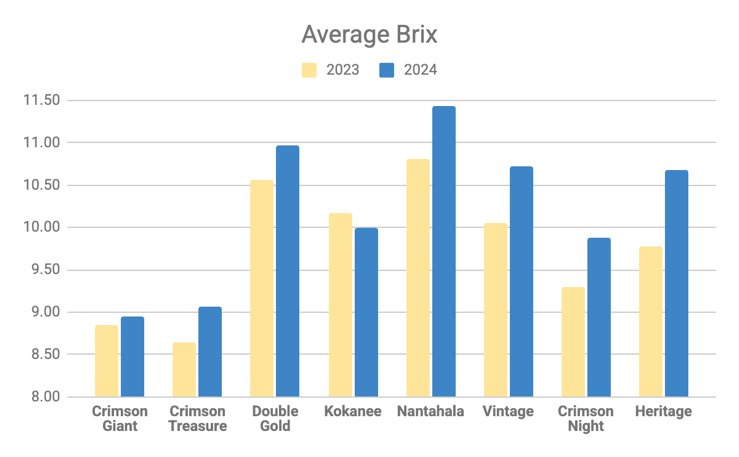
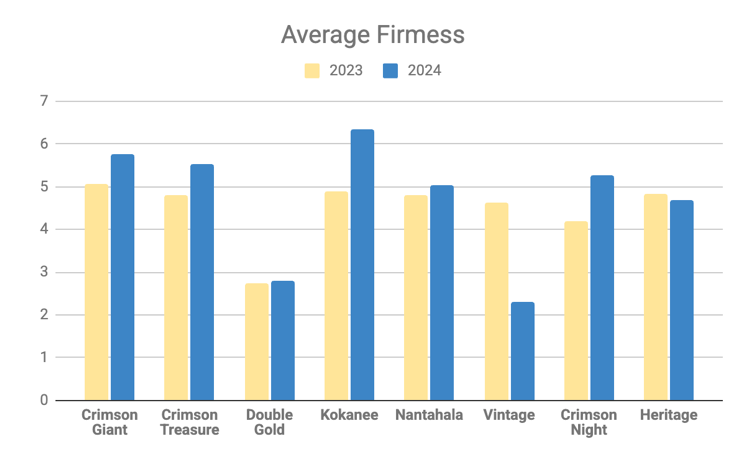
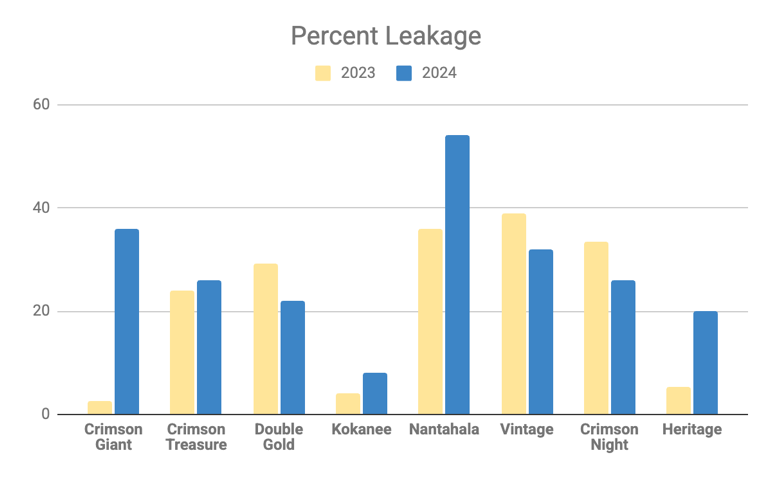
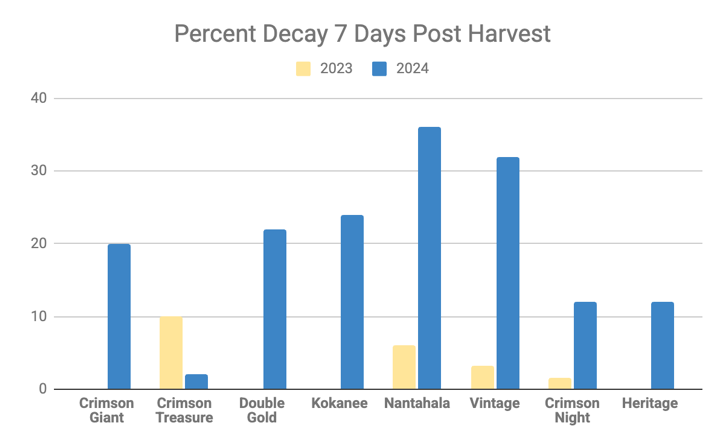
Fruit quality results across several metrics, including firmness and post-harvest stability from 2023 and 2024 seasons are shown in Figure 1. Henderson County received 18.96 inches of rain in September 2024 during the late raspberry harvest resulting in an increase in decay during the 2024 season.
Key findings and cultivar performance
Two cultivars emerged as particularly promising for commercial production in western NC, while four were concluded to be unsuitable for the region.
Top performers
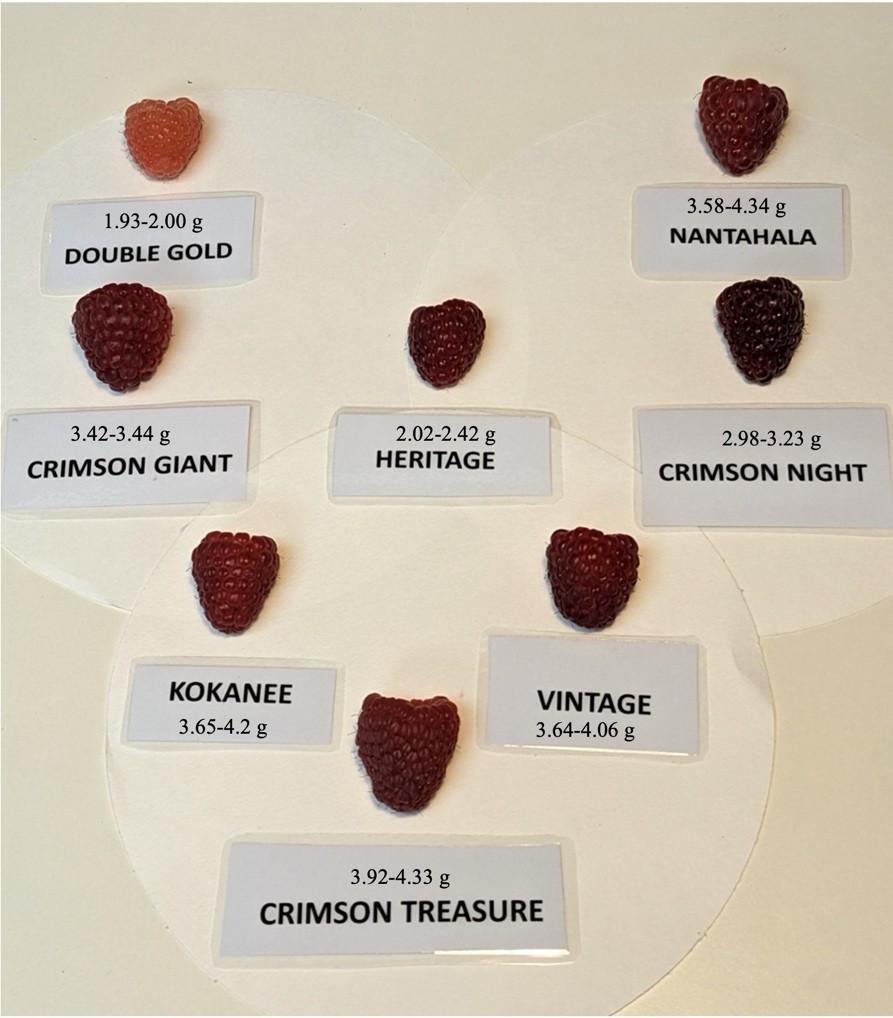
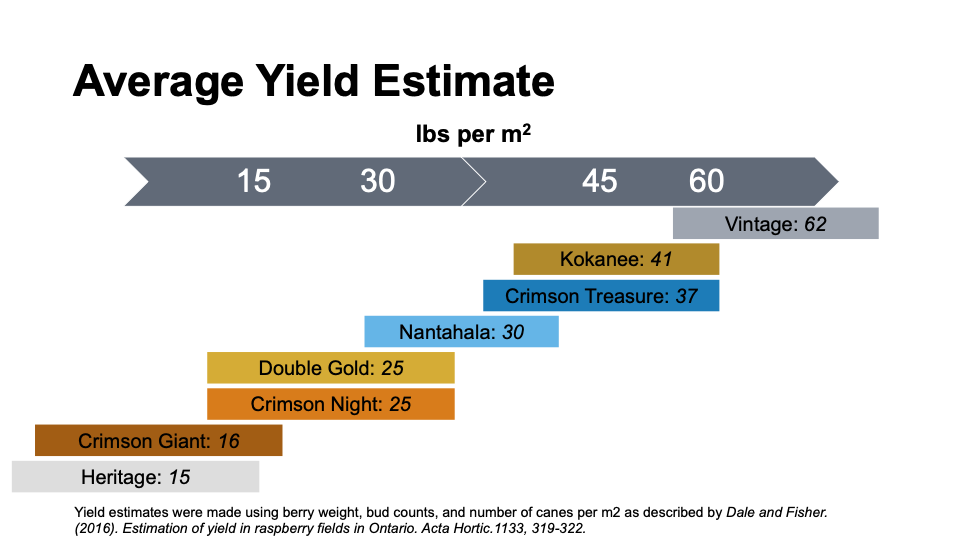
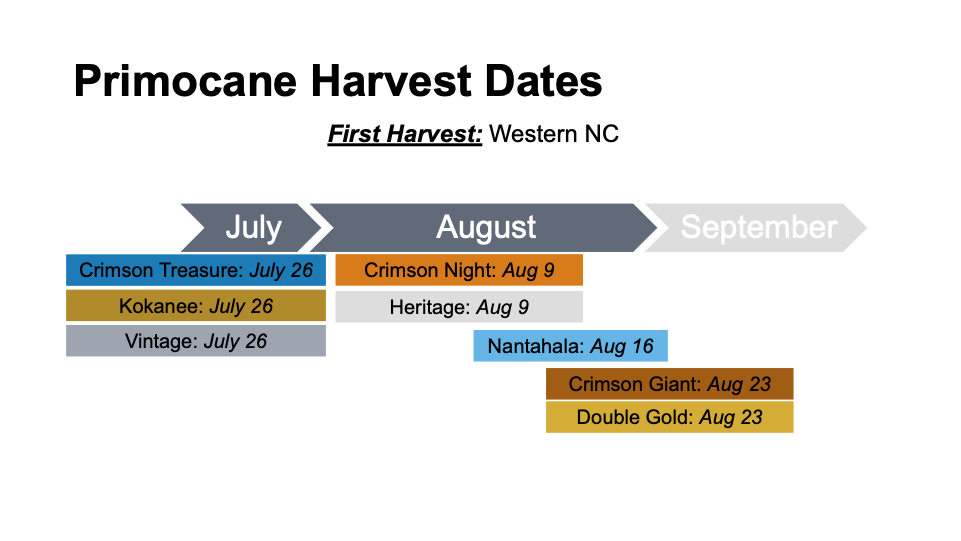
- Crimson Treasure: This cultivar produced large berries (Figure 2) with high yield potential (Figure 3) and early harvest (Figure 4). It emerged late enough in the spring to avoid cold damage and performed well in taste tests. Crimson Treasure had the most compact plant architecture in the study making it easy to manage and fruit held its red color in storage. Based on this study, Crimson Treasure is recommended for commercial production.
- Kokanee: Showed commercial potential; Kokanee had large berries (Figure 2) with excellent storage qualities, no decay and minimal leakage. While it offered high yields (Figure 3) and early harvest (Figure 4), it did suffer some minor “tip burn” due to early spring emergence. Fruit also maintained red color in storage.
- Nantahala: Has long been used for raspberry production in NC and was used as a control in the study. This cultivar had the highest brix and leakage of any other cultivar in the study. Yield potential was lower than Kokanee and Crimson Treasure in 2023 but comparable in 2024.
Worst performers
- Vintage: Maintained solid firmness and sugar levels, but showed higher leakage and poor storage potential. Although storage was an issue, Vintage had the highest yield potential (Figure 3) and performed the best in taste tests. It might be a good choice for u-pick operations where flavor matters and storage is not a factor. Fruit turned darker red to purple in storage.
- Crimson Night: Had low yield estimates and high levels of leakage.Berries turned darker purple in storage giving taste testers the impression they were no longer fresh.
- Crimson Giant: Had a large berry size but second to lowest yield estimates. It also had a high percentage of leakage even though it had good berry firmness, which is likely due to the increased rain events in the fall during its peak harvest time.
- Double Gold: This cultivar showed the least potential for the area. Its tall canes made harvesting difficult, and the fruit was susceptible to sun scald and poor storage durability. It had the smallest berry size and lowest yield estimates.
Figure 1: Fruit Quality across three harvest dates during the 2023 and 2024 seasons: Average brix, % Leakage, Average firmness, and % Decay after seven days in storage. Firmness measured subjectively on a scale of 1 to 9 where 1=very soft, 5=moderate firmness, and 9=firm.
| Cultivar | Brix Average 2023 | Brix Average 2024 | % Leakage 2023 | % Leakage 2024 | Firmness Average 2023 | Firmness Average 2024 | % Decay 2023 | % Decay 2024 |
|---|---|---|---|---|---|---|---|---|
| Crimson Giant | 8.85 | 8.95 | 2.67 | 36.00 | 5.05 | 5.76 | – | 20 |
| Crimson Treasure | 8.64 | 9.07 | 24.00 | 26.00 | 4.79 | 5.52 | 0 | 2 |
| Double Gold | 10.56 | 10.96 | 29.33 | 22.00 | 2.73 | 2.80 | 10 | 22 |
| Kokanee | 10.17 | 10.00 | 4.00 | 8.00 | 4.89 | 6.34 | 0 | 24 |
| Nantahala | 10.81 | 11.43 | 36.00 | 54.00 | 4.81 | 5.02 | 0 | 36 |
| Vintage | 10.05 | 10.72 | 39.00 | 32.00 | 4.63 | 2.32 | 6.1 | 32 |
| Crimson Night | 9.30 | 9.88 | 33.33 | 26.00 | 4.20 | 5.27 | 3.3 | 12 |
| Heritage | 9.77 | 10.68 | 5.33 | 20.00 | 4.84 | 4.68 | 1.5 | 12 |
Figure 2. Average berry weight, size and shape for both 2023 and 2024 seasons.
| Cultivar | Weight |
|---|---|
| Nantahala | 3.58 – 4.34 g |
| Heritage | 2.02 – 2.42 g |
| Crimson Treasure | 3.92 – 4.33 g |
| Crimson Night | 2.98 – 3.23 g |
| Crimson Giant | 3.42 – 3.44 g |
| Double Gold | 1.93 – 2.00 g |
| Vintage | 3.64 – 4.06 g |
| Kokanee | 3.65 – 4.2 g |
Figure 3. Yield estimates for 2024 season.
Yield estimates were made using berry weight, bud counts, and number of canes per m2 as described by Dale and Fisher. 2016. Estimation of yield in raspberry fields in Ontario. Acta Hortic. 1133, 319-322.
| Cultivar | lbs per m2 |
|---|---|
| Heritage | 15 |
| Crimson Giant | 16 |
| Crimson Night | 25 |
| Double Gold | 25 |
| Nantahala | 30 |
| Crimson Treasure | 37 |
| Kokanee | 41 |
| Vintage | 62 |
Figure 4. Average first harvest dates for each cultivar, Western North Carolina.
| Cultivar | Average First Harvest Date |
|---|---|
| Crimson Treasure | July 26 |
| Kokanee | July 26 |
| Vintage | July 26 |
| Crimson Night | August 9 |
| Heritage | August 9 |
| Nantahala | August 16 |
| Crimson Giant | August 23 |
| Double Gold | August 23 |
Outcomes
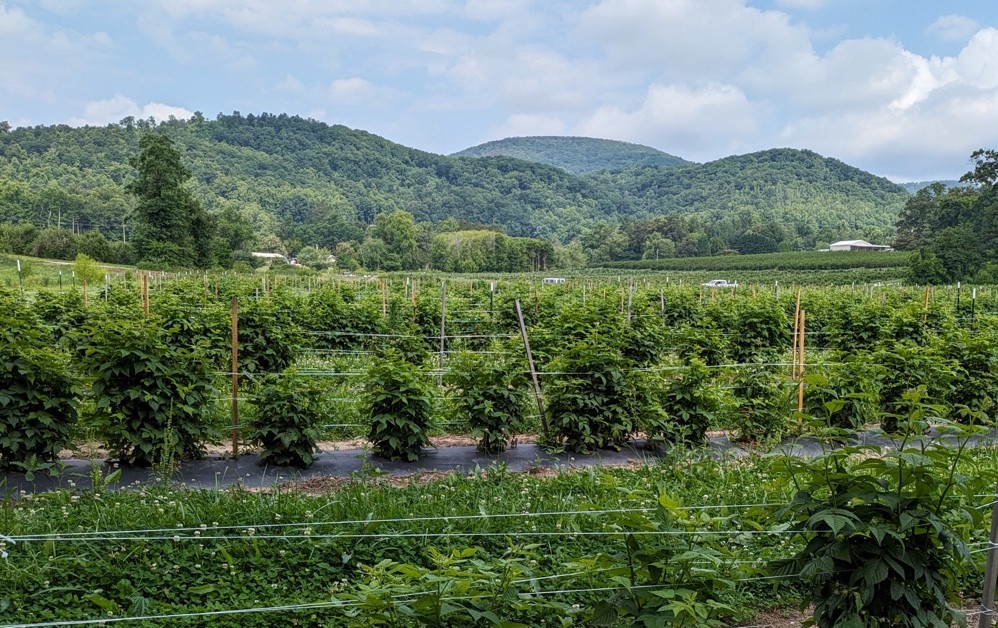
In 2025, several commercial acres of Crimson Treasure were planted in western NC as a result of this study and 2026 will be the first full harvest season. Yields, shippability, and shelf life of this cultivar will be evaluated this year in order to help inform growers looking to expand or add raspberry production to their operation. Due to the compact architecture of Crimson Treasure and the early primocane harvest window, growers are experimenting with using tomato trellising techniques and higher density spacing in order to lower input costs and maximize yield potential per acre (Figure 5). These cultural practices will be followed in the coming years to help establish production recommendations for specific cultivars. Heat-tolerance and longevity information will also be collected the next two years for the top performing cultivars, Crimson Treasure and Kokanee. Be on the lookout for a fact sheet through NC State Cooperative Extension in the next year highlighting these additional findings.
Additional Resources:
Dale and Fisher. 2016. Estimation of yield in raspberry fields in Ontario. Acta Hortic. 1133, 319-322.