Ash Sial, Department of Entomology, University of Georgia
Table of Contents
Introduction
Chilli thrips (Scirtothrips dorsalis Hood; Thysanoptera: Thripidae) have emerged as a serious pest threat to blueberry production in the southeastern United States. Originally native to Asia, this invasive species has established populations in Florida, Louisiana, Texas, and most recently Georgia. The pest poses a significant challenge to fruit producers due to its broad host range, rapid reproductive rate, and ability to cause severe foliar damage leading to yield loss and potential bush decline.
Identification and biology
Adult chilli thrips are extremely small, about 1-2 mm (less than 1/16 inch) long, and pale yellow with dark fringed wings and faint brown bands on the abdomen. They are smaller than the common flower thrips frequently observed in blueberry blooms (Fig. 1).
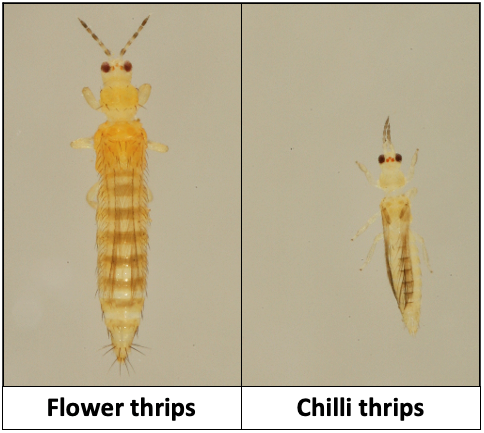
The chilli thrips life cycle includes four stages: egg, larva, pupa, and adult. Females insert kidney-shaped eggs into soft plant tissues using a sharp ovipositor. Eggs hatch in 5-8 days, followed by two actively feeding larval instars that last approximately 8-10 days. Two non-feeding pupal stages occur in leaf litter, curled leaves, or soil. Under warm conditions (77-81°F), the life cycle can be completed in about 18-20 days, allowing for rapid population buildup.
Feeding damage and symptoms
Chilli thrips feed primarily on young blueberry foliage following summer pruning, typically from June through September. Both adults and larvae use their mouthparts to puncture epidermal cells and feed on mesophyll tissues.
Initial symptoms include leaf bronzing, distorted or cupped leaves, and browning along leaf veins and petioles. As infestations increase, leaves curl, dry, and eventually drop. Repeated infestations can significantly reduce plant vigor, delay new flush growth, and reduce fruit set in the following season. In severe cases, plants may exhibit dieback or even mortality if left unmanaged.
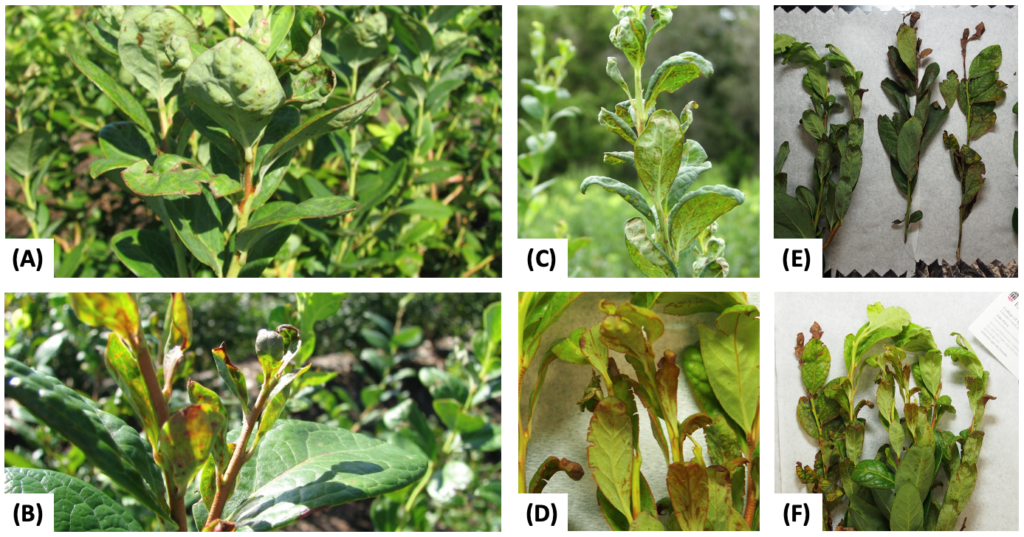
(Photos A-C by O. Liburd, UF, and Photos D-F by J. McCulloch, UGA)
Distribution and monitoring
In Georgia, chilli thrips were first detected in 2022 and have since been confirmed in multiple southern counties. Populations tend to be patchy, forming “hot spots” in fields before spreading to adjacent bushes as foliage quality declines.
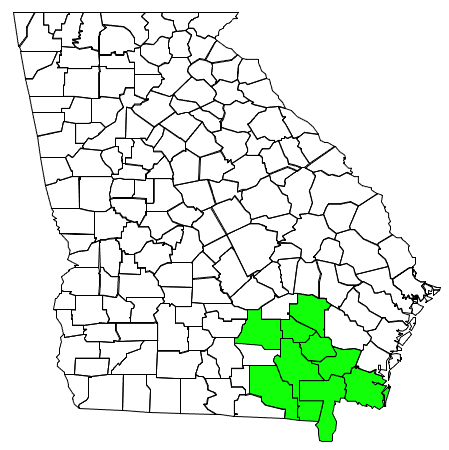
Chilli thrips have been detected in the highlighted counties, including Appling, Bacon, Brantley, Camden, Charlton, Clinch, Coffee, Pierce, and Ware counties.
Early detection is crucial. Growers should regularly inspect new growth after pruning using a 10× hand lens or by tapping foliage onto a white surface to look for the small, active insects. Yellow or white sticky traps can also help monitor adult activity. Bronzed or curled leaves are often the first visible indicator of an infestation.
Management and control
Effective chilli thrips management requires an integrated pest management (IPM) approach that combines cultural, biological, and chemical tactics.
Cultural control
- Remove alternative host plants and weeds in and around blueberry fields that may harbor thrips populations.
- Avoid excessive nitrogen fertilization that stimulates tender flush growth attractive to thrips.
- Prune infested shoots and destroy plant debris to reduce overwintering sites.
Biological control
Several natural enemies feed on chilli thrips, including:
- Orius insidiosus (minute pirate bug)
- Amblyseius swirskii (predatory mite)
- Geocoris spp. (big-eyed bugs)
Conservation of these beneficial species can help suppress thrips populations naturally. Avoid unnecessary broad-spectrum insecticide applications that can disrupt these predators.
Chemical control
Insecticides remain the primary management tool. An economic threshold may be developed in the future, but at this time it is recommended that applications begin as soon as chilli thrips are detected, since they can build up high populations in a short amount of time. Effective products registered for blueberries include:
- Delegate (spinetoram; IRAC group 5) – controls larvae and adults; systemic and translaminar activity.
- Apta (tolfenpyrad; IRAC group 21A) – inhibits feeding in both larval and adult stages.
- Rimon (novaluron; IRAC group 15) – insect growth regulator that affects eggs and larvae.
- Assail (acetamiprid; IRAC group 4A) and Sivanto (flupyradifurone; IRAC group 4D) – systemic insecticides effective on larvae and adults.
- Entrust (spinosad; IRAC group 5) – primary option for organic production.
Rotate insecticides with different modes of action (IRAC codes) to prevent resistance development. Follow all label directions carefully, including preharvest intervals (PHIs) and pollinator protection guidelines.
Research and outlook
University of Georgia researchers, in collaboration with colleagues across the Southeast, are currently investigating chilli thrips biology, ecology, and management in blueberry systems. Ongoing projects are focused on identifying optimal monitoring tools, refining threshold-based management strategies, and assessing potential resistance risks.
Given the experiences in Florida, where growers have required up to 9-18 insecticide applications per season in severe cases, Georgia growers should remain vigilant and proactive. Early detection and rapid response are key to minimizing long-term impact.
Summary
Chilli thrips represent a rapidly emerging pest threat to blueberry production in the southeastern United States. Their ability to reproduce quickly, cause extensive foliar injury, and persist across seasons underscores the need for vigilant monitoring and integrated management. Through research, education, and grower engagement, the southeastern blueberry industry can adapt effective strategies to mitigate this pest’s impact.
Contact:
Dr. Ash Sial, Professor and Extension Entomologist
Department of Entomology, University of Georgia
Email: ashsial@uga.edu
References:
Liburd, O. E., B. R. Panthi, and D. A. Phillips. 2020. Chilli Thrips on Blueberries in Florida. ENY-2053, UF/IFAS Extension.