Dr. Jensen Hayter is an Assistant Professor and Extension Specialty Crop Pathologist for the University of Tennessee, Knoxville.
About Me
I joined the University of Tennessee in November 2024 as an assistant professor and Extension specialty crop pathologist. Since arriving my duties have expanded to include specialty crop entomology. My main objectives are to 1) provide agents, growers, and other stakeholders with timely and impactful training and recommendations and 2) focus my research on topics of concern to Tennessee growers. I aim to collaborate with colleagues across the Southeast region to improve pest and pathogen management in specialty crops, particularly small fruit.
I grew up bouncing around the West, but the one place my family always returned to was the fruit-growing region of the Columbia Basin in Washington. As a kid I took fresh blueberries, raspberries, and blackberries for granted. I never imagined that one day I would be a scientist working to help growers sustainably produce these crops in the South. My academic career began at Brigham Young University where I graduated with a B.S. in Microbiology. I participated in research aimed at improving legume and potato disease management using cultural methods of disease suppression. I then completed my Ph.D. in Plant Pathology at Texas A&M University where I studied the effects of landscape variation on pest and pathogen movement. It was during this time that I was introduced to the fascinating world of insect behavioral ecology, and I ended up receiving training in both entomology and plant pathology.
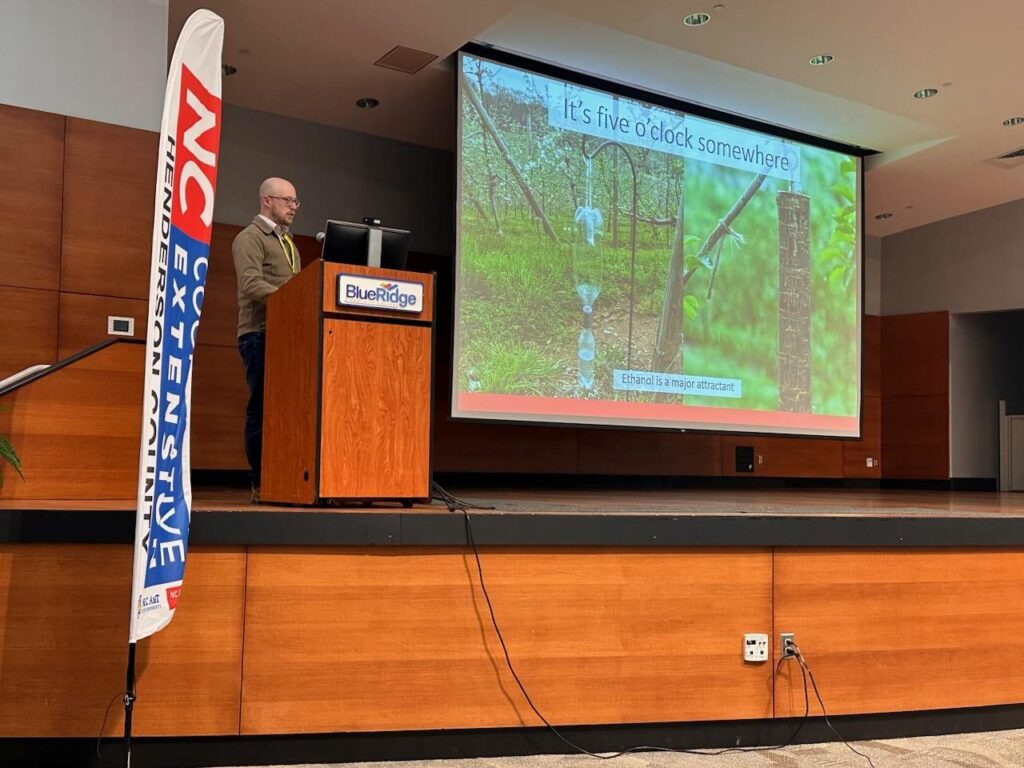
Upon graduation, I moved to NC State University where I worked as a postdoctoral researcher at the Mountain Horticultural Crops Research and Extension Center in Dr. Jim Walgenbach’s entomology lab. There I studied the ecology and distribution of ambrosia beetles, polyphagous pests that attack weakened apple trees and contribute to Rapid Apple Decline (RAD), a condition that leads to a significant reduction in tree health and even death of affected trees. We are now working to better understand how unmanaged forests and riparian areas contribute to ambrosia beetle risk. I have now been at the University of Tennessee for over a year and have found myself very happily involved in the world of small fruit research. Tennessee strawberry growers found their way to my office very quickly to request help with Neopestalotiopsis and anthracnose control. I’m looking forward to continued collaboration with my colleagues in the Southeast as we work to improve small fruit production.