Drew Harner, Ph.D., Assistant Professor and Extension Specialist
Dana Aćimović, M.S., Associate Extension Agent, Virginia Cooperative Extension Roanoke-Botetourt
Table of Contents
Grapevine tissue sampling is a core component of a vineyard nutrient management program. It can serve as a diagnostic tool when grapevines are expressing visual symptoms of potential deficiency or toxicity, as well as help producers understand whether grapevines are absorbing sufficient nutrients to sustain proper vegetative growth and fruit production. In both cases, tissue sampling can help inform whether supplemental fertilization is necessary and identify the appropriate nutrient rates needed to maintain grapevine health and optimize yield.
Typically, vegetative tissues are collected at key growth stages, including full bloom (Eichhorn-Lorenz Stage 23) or véraison (Eichhorn-Lorenz Stage 35; Coombe 1995), when grape maturation begins. There are benefits and drawbacks to sampling at either time. Nutrient concentrations measured in tissues sampled at bloom typically reflect vine nutrient reserves from the previous season, as these reserves play a critical role in supporting early-season growth and development. Bloom-time sampling also offers an opportunity to address any deficiency issues via fertilizer application earlier in the season.
In contrast, nutrient concentrations measured at véraison reflect the cumulative effects of nutrient uptake and allocation during the current growing season. As a result, they often provide a more accurate indication of the vine’s current macronutrient status. However, sampling at this stage leaves limited time and fewer management options for correcting nutrient deficiencies within the same season.
Adding further complexity to the issue, there has been ongoing debate regarding which tissue type (petioles vs. leaf blades) provides the most reliable results for grapevine nutrient analysis. Evaluating these tissue sampling protocols was one of the many objectives of the High Resolution Vineyard Nutrient Management Project, a multiyear USDA Specialty Crop Research Initiative (SCRI)-funded project that featured nutrition experiments across the U.S. led by researchers at Washington State University, Oregon State University, UC Davis, Cornell University, Rochester Institute of Technology, and Virginia Tech.
One experiment performed in Virginia sought to understand how the timing of tissue sampling within a day affected petiole and leaf blade nutrient concentrations. The study compared petioles and leaf blades because these tissues serve different functions within the vine. Petioles mainly transport water and nutrients, so their nutrient concentrations may change throughout the day as weather conditions and vine water use fluctuate. In contrast, leaf blades are primarily responsible for photosynthesis and other metabolic processes, which may make their nutrient concentrations more stable and less affected by short-term environmental changes.
Previous work from Georgia performed by Dr. Cain Hickey explored this theme in Chambourcin vines and indicated that concentrations of macronutrients may not significantly vary throughout the day at bloom and véraison (Hickey et al. 2021). While only total nitrogen (N), phosphorus (P), and potassium (K) were tested, this would mean that tissue samples could be collected at any time during the day in similarly humid, warm regions.
However, although no statistically significant differences were detected between predawn and solar noon sampling times in that study, petiole K concentrations at véraison declined by nearly 10% over the course of the day. Given the high mobility of K within the plant vascular system, this trend suggests that petiole K concentrations may be influenced by the daily changes in water availability and vine physiological activity. In our study, we quantified concentrations of macronutrients (N, P, K, calcium [Ca], magnesium [Mg]) and micronutrients (boron [B], zinc [Zn], iron [Fe], manganese [Mn], copper [Cu]) in petioles and leaf blades of Chardonnay and Chardonel grapevines in the northern Shenandoah Valley in Virginia. We targeted véraison and sampled tissues across 3 years to account for seasonal differences (Figures 1 and 2).
Across sampling times, Chardonnay petiole K concentrations were 7% lower at midday than in the morning (Figure 2A, Table 1). This trend is consistent with the results reported by Hickey et al. (2021). Chardonnay petiole B concentrations also appeared to vary throughout the day; however, the temporal patterns were not consistent across years (Figure 2B, Table 2).
In contrast to Chardonnay, similar temporal trends were not observed in Chardonel tissues. Instead, leaf blade K and Mg concentrations appeared to be more responsive to sampling time than petiole concentrations. However, the magnitude and direction of these responses varied among growing seasons (Figure 2C and 2D, Table 2).
Our results indicate that the time of day at which grapevine tissues are collected has relatively little influence on the concentrations of most macro- and micronutrients measured in Chardonnay and Chardonel grapevines. From a practical perspective, these findings provide flexibility for growers when collecting tissue samples during the busy growing season. Nevertheless, to minimize variability and improve consistency among samples, it remains advisable to collect tissues at approximately the same time of day when comparing vineyards, treatments, or years. Particular attention should be given to K when interpreting petiole analyses, especially during periods of high vine water use or water stress. Ongoing analyses are also underway to determine if fruit tissues can be sampled at véraison as an indicator of vine N status, as well as a potential tool for predicting yeast assimilable nitrogen (YAN) in fruit at harvest.
Acknowledgements: This research was initiated by the National Grape Research Alliance (NGRA) and was funded through the National Institute of Food and Agriculture’s (NIFA) Specialty Crop Research Initiative Coordinated Agricultural Projects (CAP) grant, project Award Number: 2020-51181-32159. Additional funding was provided by the Virginia Wine Board and the Virginia Agricultural Council.
Figures and Tables
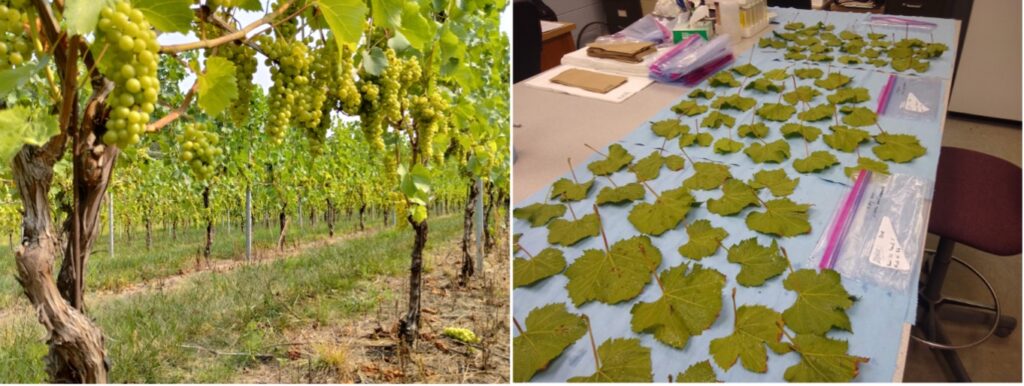
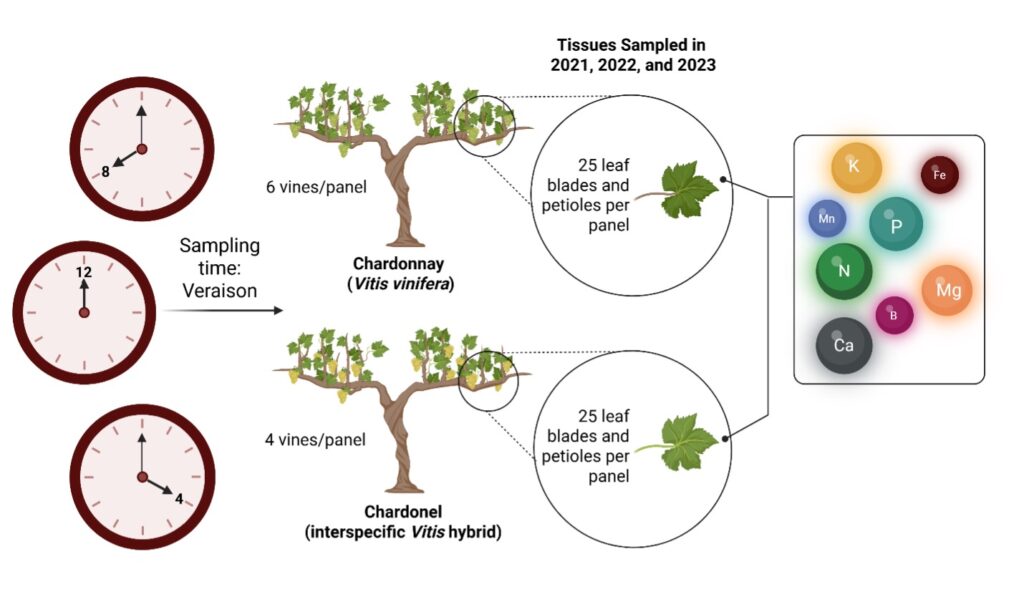
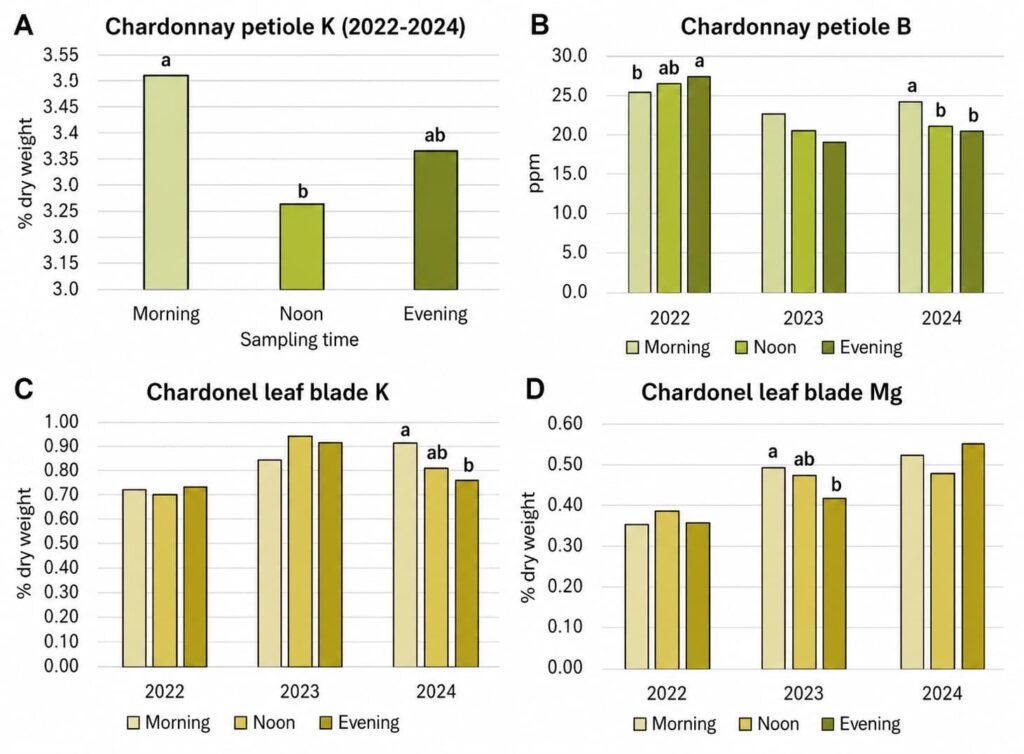
Table 1. Average concentrations of K (%) in Chardonnay petioles when sampled from mature, field-grown grapevines sampled at véraison (E-L stage 35). Values represent means of all three sampling years (2022, 2023, and 2024) per sampling time.
| Chardonnay Petiole K (%) | ||
|---|---|---|
| Morning | 3.51 a | |
| Noon | 3.26 b | |
| Evening | 3.36 ab | |
| pTIME | 0.034 | |
| pYEAR | < 0.01 | |
| pTIME*YEAR | 0.641 | |
Table 2. Concentrations of boron in petioles sampled from mature, field-grown Chardonnay vines and of potassium (K) and magnesium (Mg) in leaf blades sampled from mature, field-grown Chardonel vines at véraison (E-L 35) in 2022, 2023, and 2024. Different letters within each column indicate statistical differences (p < 0.05) between sampling times within each year.
| Chardonnay Petiole B (ppm) 2022 | Chardonnay Petiole B (ppm) 2023 | Chardonnay Petiole B (ppm) 2024 | Chardonel Leaf K (%) 2022 | Chardonel Leaf K (%) 2023 | Chardonel Leaf K (%) 2024 | Chardonel Leaf Mg (%) 2022 | Chardonel Leaf Mg (%) 2023 | Chardonel Leaf Mg (%) 2024 | |
|---|---|---|---|---|---|---|---|---|---|
| Morning | 25.0 b | 23.0 a | 24.0 a | 2.76 a | 2.23 a | 1.94 a | 0.68 a | 0.69 a | 0.81 a |
| Noon | 27.0 ab | 20.0 a | 21.0 b | 2.67 a | 2.64 a | 1.96 ab | 0.79 a | 0.63 ab | 0.91 a |
| Evening | 27.0 a | 19.0 a | 21.0 b | 2.53 a | 2.44 a | 1.35 b | 0.74 a | 0.67 b | 0.97 a |
← Scroll to view additional columns →
References
Coombe, B.G. 1995. Growth Stages of the Grapevine: Adoption of a System for Identifying Grapevine Growth Stages. Australian Journal of Grape and Wine Research 1(2): 104-110. https://doi.org/10.1111/j.1755-0238.1995.tb00086.x.
Hickey, C., Breeden, S., MacAllister, C., Lessl, J., and Schreiner, R.P. 2021. The Fundamentals of Grapevine Tissue Sampling for Nutrient Analysis. Penn State Extension. https://extension.psu.edu/the-fundamentals-of-grapevine-tissue-sampling-for-nutrient-analysis.