Elizabeth Cieniewicz, Plant and Environmental Sciences Department, Clemson University
Berry crops are susceptible to dozens of viruses, with new ones being discovered regularly. While only a few of these viruses consistently cause problems, viruses can be a major limiting factor in berry production, especially for caneberries. In the southern region, in strawberry and blueberry, virus outbreaks are rare compared to, for example, blackberry, in which viruses tend to infect plants within 1-3 years of planting. Blackberry is a magnet for viruses. By the time you see symptoms, the plant may have three or more viruses. Virus symptoms in blackberry are quite diverse, with many variations of foliar chlorotic patterns (Fig. 1) accompanying problems with fruit set and general plant decline. The viruses are all unique, with different ways of getting around, such as by insect vectors, pollen, seed, and, most importantly and most efficiently, by vegetative propagation.
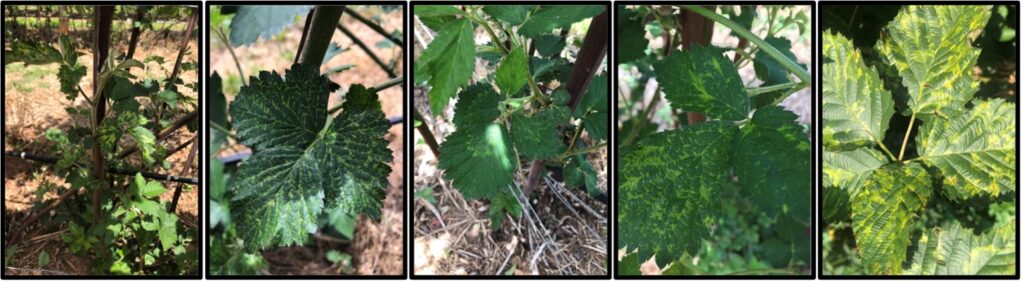
Management options are limited. That is, once a plant is infected, it is infected for life. Therefore, nearly all management practices aim to prevent infection in the first place. I like to categorize preventive strategies into two groups- those targeting initial inoculum, i.e., the first introduction of a virus into a field, and those targeting secondary spread of viruses.
The options for targeting secondary viral spread are relatively limited because you have to know how they are spreading in order to stop the spread. Research has revealed transmission mechanisms for some berry viruses. For example, blackberry yellow-vein associated virus is transmitted by whiteflies, and strawberry mild yellow edge virus and strawberry mottle virus are both transmitted by the strawberry aphid. For many other berry viruses, we don’t know how they are transmitted from plant to plant. Further, some viruses, such as raspberry bushy dwarf virus, are transmitted through pollen, making disruption of transmission difficult. Even if we know the vector, managing secondary spread of vector-borne viruses can be challenging because we don’t always know the best time and best method to use to control the vectors. So, the most important and effective strategy is to start with clean plants.
What Are Clean Plants?
The USDA National Clean Plant Network (NCPN) supports clean plant centers around the U.S. that provide services including virus diagnostics, virus elimination therapies, and maintenance of clean plants in foundation collections. The NCPN is divided into subgroups, including NCPN-Berries and NCPN-Grapes, among others. There are NCPN-Berries centers in Oregon, Arkansas, North Carolina, and California. NCPN-Grapes includes centers in Washington, California, New York, Missouri, North Carolina, and Florida. The NCPN is unique because it brings together industry members, federal and state regulators, extension advisors, and researchers to further the mission of providing clean plants for vegetatively propagated specialty crops in the U.S. (https://www.nationalcleanplantnetwork.org/).
It sounds simple, but in practice, what defines a “clean plant” is not always clear. So, let’s define a few terms.
- Clean plant: a plant that is derived from virus-tested, virus-negative stock plants.
A plant doesn’t have to be “virus-free” to be clean. Clean plants are considered free of targeted viruses. - Virus-free: a plant with NO viruses.
This term is used often, both by scientists and stakeholders. Virus-free is very difficult to guarantee, so I recommend avoiding this phrase. - Certified: a plant that is certified by a certification program administered by a state department of agriculture.
Not all U.S. states have certification programs for all berry crops. Also, “certified” does not necessarily mean “clean.” - Foundation: Foundation plants are clean plants that are maintained by NCPN-affiliated clean plant centers.
Nurseries should be sourcing their material from foundation collections.
Economic benefits of NCPN centers are massive. Some studies have estimated up to 140:1 return on investment in clean plant centers (Fuchs et al., 2021). If the state has a certification program for a particular crop, then foundation stock is registered with the state department of agriculture that administers the certification program. The foundation plants are maintained at NCPN centers, and material in G2-G4 blocks is maintained by nurseries and certified by the state department of agriculture. NCPN-Berries maintains more than 300 berry accessions and NCPN-Grapes centers collectively have more than 1,000 grape accessions (https://www.nationalcleanplantnetwork.org/).
What You Can Expect With Clean Plants
I suggest that before you buy berry plants from a nursery, you verify that they sourced the propagative plant materials from NCPN-affiliated clean plant centers. Keep in mind that it is not practical to test every plant for every virus, so the plants you order to plant for fruit production will likely not have been virus-tested. But these plants-for-planting should certainly be derived from virus-tested, clean mother stocks, and nurseries should be able to verify this.
Until we can identify which viruses actually cause harm and gain a more holistic understanding of their biology and ecology, it is challenging to reduce secondary spread of viruses in berry crops. My lab’s research in South Carolina with blackberry viruses has demonstrated that younger plantings (1-3 years) harbor fewer viruses than older plantings (4+ years). This might sound like a statement of the obvious, but it shows that new plants are mostly clean, indicating that most nurseries are doing a good job of providing them.
We also found many viruses in wild Rubus plants collected from farm edges. Several of the viruses were found both in the blackberry plantings and in the wild Rubus plants, with similar genomes, suggesting that the viruses are moving between wild Rubus and the farms (Schnabel et al., 2025). All of this together means that the viruses are largely invading blackberry plants after planting, from sources that could include older nearby plantings and wild Rubus at the farm borders.
Virus outbreaks in strawberry are rare but can be severe. The last major strawberry virus outbreak in the Southeast occurred in 2012-2013, pointing toward a single nursery source in Nova Scotia, Canada (Samtani et al., 2023). Since the 2012-13 outbreak, nurseries and growers have been more vigilant and committed to producing and planting clean plants (Samtani et al., 2023).
We need to conduct more research to understand the biology and ecology of the major berry viruses before we can make solid recommendations for preventing secondary spread of viruses in the environment. However, the most effective way to reduce the impacts of viruses in berry crops is to start with clean plants. They are worth the investment.
References
Fuchs, M., Almeyda, C. V., Al Rwahnih, M., Atallah, S. S., Cieniewicz, E. J., Farrar, K., et al. 2021. Economic studies reinforce efforts to safeguard specialty crops in the United States. Plant Dis. 105:14–26.
Samtani, J.B. et al. 2023. Mixed Infection of Strawberry Mottle Virus and Strawberry Mild Yellow Edge Virus in the Southeastern United States. Virginia Cooperative Extension, HORT 268P (SPES-488P). https://www.pubs.ext.vt.edu/content/pubs_ext_vt_edu
Schnabel, E., Augusto, C., Xavier, D., Whitfield, A. E., Dubrow, Z., Pham, G., et al. 2025. Exploring the Virome of Blackberry and Wild Rubus spp. in South Carolina. Phytobiomes. 9:80–94.