Brett Blauuw, University of Georgia Department of Entomology
Table of Contents
Why Grape Root Borer Is a Major Threat in Southeastern Vineyards
Growing grapes in the Southeast is not for the faint of heart. While the climate is conducive for plant development and growth, the high heat and humidity are also favorable for a variety of intense insect pests and diseases that subsequently require demanding management programs to actually be fruitful. It is tough enough battling those pests and diseases that you can see attacking the vine, but there is one major pest that often goes unnoticed, secretly feeding on the vines underground: the grape root borer, Vitacea polistiformis (Harris) (Lepidoptera: Sesiidae). By the time you notice the symptoms aboveground from this sneaky little bugger, the damage belowground is already underway. Vines slowly lose vigor and yields diminish, while the larvae quietly tunnel through roots.
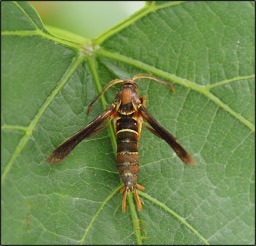
With its inconspicuous nature, grape root borer is one of the most destructive vine pests in the Southeast. The adults, which are a type of clearwing moth, are reddish brown, active during the day, and resemble paper wasps, particularly when in flight (Figure 1). The adults generally emerge late June or early July and can be found flying around vines, but unlike wasps, they cannot bite or sting, so they are only a danger to the vines. The grape root borer females lay their eggs at the base of both wild and cultivated grapes vines, with the larvae hatching and subsequently attacking the roots. The larvae are cylindrical, cream-colored with a brown head, and 1.5 inches long when mature. The life cycle of grape root borer is completed within 1 to 2 years, where larvae spend upwards of 23 months feeding on root tissue, subsequently damaging vines by girdling the roots, thus cutting off nutrients and water to the remainder of the plant. It is estimated that a single larva feeding on the root system can reduce a vine’s yield by up to 50% (Dutcher and All 1979). Thus, several larvae within a root system can cause substantial injury to vines through the reduction of fruit quality and eventual vine death.
Monitoring and Detecting Grape Root Borer
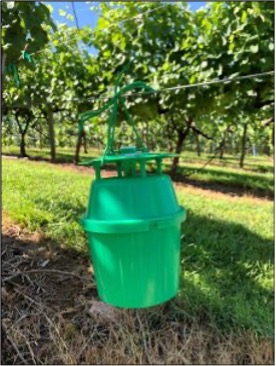
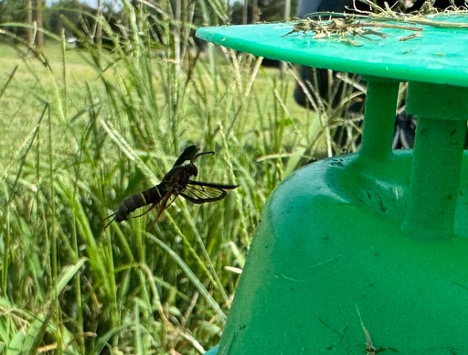
Since grape root borer adults and the larvae often go unnoticed until the vine begins to decline, management can be a little tricky. Fortunately, grape root borer adults can be monitored using a simple bucket trap and pheromone (Figure 2). Traps and pheromone can be purchased from sites like Great Lakes IPM, and assembly instructions can be found on NC State University’s website in the article titled Do It Yourself – Grape Root Borer Monitoring. The abundance of moths captured on a weekly basis can be used to determine both presence of grape root borer in a vineyard and to determine peak activity periods, which can be used to time management activities.
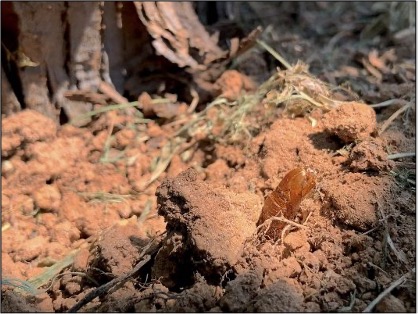
In addition, particularly in vines that have reduced vigor and/or poor fruit set, it is important to monitor the soil underneath the vines for signs of grape root borer infestation. As the adults emerge from the soil, they leave behind brown pupal cases protruding partially from the ground (Figure 3). Check the area of about 18 inches radially surrounding the base of vines. Finding the pupal cases is a good sign that the vine has been infested with grape root borer. Keeping this area clear of vegetation will aid in detection and will potentially help with control of grape root borer by increasing the exposure of their eggs to predators and desiccation. As such, one preemptive management strategy is weed control. Eliminating weeds around the base of vines reduces the sites for egg laying and improves spray coverage for grape root borer management.
Evaluating Alternative Insecticide Management Options
Damage caused by the grape root borer can result in considerable losses to commercial grape production, thus more than weed management is often needed. Although it often goes unnoticed until it is too late, damage due to grape root borer is still a key issue throughout the Southeast. One of the key management strategies for insect pests is the use of insecticides. The key insecticide labeled for grape root borer was Lorsban (chlorpyrifos), which was applied as a soil drench around the base of vines as a toxic barrier to the movement of larvae to the roots. However, since chlorpyrifos is highly toxic, the EPA has proposed a new rule to revoke the tolerances of chlorpyrifos associated with all but eleven crop uses, which include: alfalfa, apple, asparagus, cherry (tart), citrus, cotton, peach, soybean, strawberry, sugar beet, wheat (spring), and wheat (winter), but not grape. Additionally, nearly all of the labels for chlorpyrifos products have been cancelled. As such, additional options for managing grape root borer are needed now more than ever for growers.
To address this, with support from the IR-4 Project Food Crops Program (IS00443-24-GA01), a two-year (2024-2025) field trial was conducted at the University of Georgia Horticultural Research Farm in Watkinsville, GA, to assess the efficacy of seven insecticide treatments on managing grape root borer. Treatments, seven chemical and one untreated control, were applied starting in July 2024 and the number of pupal skins at the base of each vine were counted on a weekly basis from July through September in both 2024 and 2025 (Table 1). Treatment effects were detected in both years. In 2024, Agri-Mek SC (abamectin) and Altacor eVo (chlorantraniliprole) had significantly fewer pupal cases relative to the untreated control. In contrast, during 2025, only the Lorsban 4E (chlorpyrifos) plots had significantly fewer pupal cases compared with the control. Although all treatments numerically reduced pupal counts relative to untreated plots in both years, differences among treated plots were not statistically significant.
These results suggest that soil-applied abamectin and chlorantraniliprole may suppress grape root borer pupae or emerging adults during the season of application but provide limited residual protection into subsequent seasons. Conversely, the delayed efficacy observed with chlorpyrifos may reflect longer residual activity affecting newly hatched larvae, resulting in reduced adult emergence the following year. Collectively, these findings indicate that annual applications may be necessary for consistent grape root borer suppression regardless of chemistry. Additionally, note that currently neither chlorantraniliprole nor abamectin are labeled for use against grape root borer. However, when applied for other common grape pests, such as grape berry moth or two spotted spider mite, respectively, these chemistries may also help suppress grape root borer.
Table 1. Mean number of grape root borer pupal cases observed per experimental plot for each of the seven chemical treatments compared to an untreated control for the 2024 and 2025 field seasons. Within a column, means followed by same letter do not significantly differ (p > 0.05, Tukey’s HSD).
| Product | Active Ingredient | Rate/Acre | Application dates | 2024 (Mean ± Std. Error) | 2025 (Mean ± Std. Error) |
|---|---|---|---|---|---|
| Brigade 2EC | bifenthrin | 6.4 fl oz/A | 7/5/24 | 3.75 ± 0.63 AB | 1.75 ± 0.48 AB |
| Assail 70 WP | acetamiprid | 2.3 oz/A | 7/5/24, 7/19/24 | 4.75 ± 1.49 AB | 2.5 ± 0.96 AB |
| Agri-Mek SC | abamectin | 3.5 fl oz/A | 7/5/24, 7/19/24 | 1.25 ± 0.75 B | 1 ± 1 AB |
| Altacor eVo | chlorantraniliprole | 2.2 oz/A | 7/5/24, 7/19/24 | 1 ± 0.58 B | 0.75 ± 0.48 AB |
| Cormoran | acetamiprid + novaluron | 28 fl oz/A | 7/5/24, 7/19/24 | 2.5 ± 1.04 AB | 1.5 ± 0.64 AB |
| Exirel | cyantraniliprole | 20.5 fl oz/A | 7/5/24, 7/19/24 | 1.75 ± 1.18 AB | 1 ± 0.41 AB |
| Lorsban 4E | chlorpyrifos | 4.5 pt | 7/5/24 | 2 ± 0.71 AB | 0.5 ± 0.29 B |
| Untreated Control | N/A | N/A | N/A | 6 ± 0.82 A | 3.75 ± 1.71 A |
← Scroll to view additional columns →
Mating Disruption for Grape Root Borer Management
Despite the promising trends from the insecticide trial, the conclusions should be taken with a bit of uncertainty due to the variability in grape root borer biology and limitations with effective management assessment, including attraction of males from surrounding habitats and environmental loss of pupal cases. As such, until additional multi-year trials are completed to refine application timing and assess residual performance, alternative management strategies for grape root borer are needed. For example, a more environmentally friendly method for managing grape root borer is the use of sex pheromone-based mating disruption (Figure 4), which can significantly reduce vine infestation and injury due to grape root borer (Pfeiffer et al. 2010).
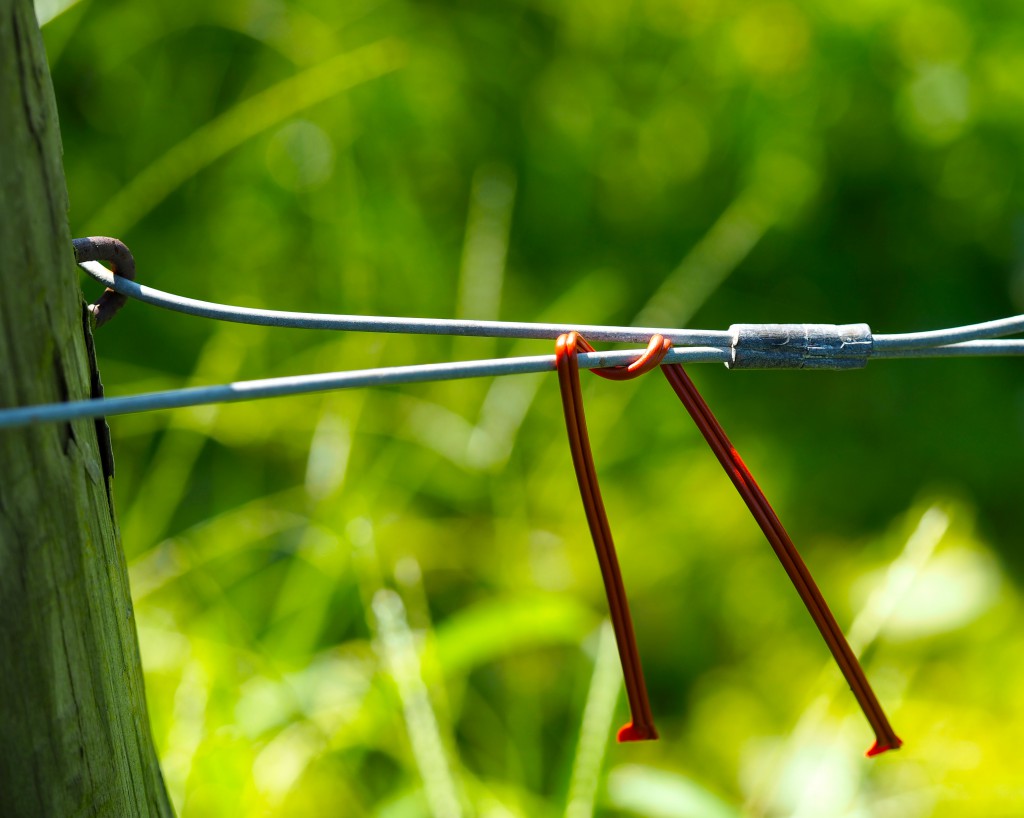
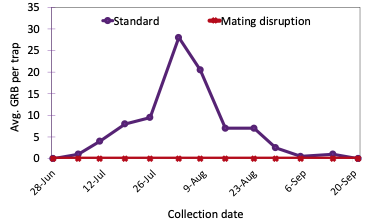
Through the deployment of sufficient pheromone-filled dispensers within a vineyard, mating disruption works by making it difficult for male grape root borer moths to find females to mate, and without mated females, there are no new larvae to attack the vines. Mating disruption efficacy can be monitored through the deployment of the pheromone-baited bucket traps (Figure 2). In principle, if the mating disruption dispensers are effective, males are not only unable to find the female moths, they are also unable to find the bucket traps. This is known as “trap shut down,” and thus, in vineyards under conventional management strategies, pheromone-baited bucket traps will likely catch numerous moths, whereas these traps in a vineyard under mating disruption with collect few, if any, moths (Figure 5). Due to the lifecycle of grape root borer, for the best results the entire vineyard needs to be under mating disruption for at least two years, but after two consecutive years of use, it can be really effective at reducing the grape root borer pressure, and ultimately damage within the vineyard.
While mating disruption is potentially the most effective management tool for grape root borer, the entirety of a vineyard needs to be under “disruption,” which can make mating-disruption a costly method in terms of time and money. Additionally, mating disruption works best on vineyards with flat terrain and with production area greater than 5 acres. Furthermore, the only commercially available mating disruption product, ISOMATE GRB-Z, has undergone a new label registration through EPA, which as of 2026 has not been approved for national use. CBC America has worked with several states and the EPA to receive a Section-18 for the 2026 season, but this label is only good for Delaware, Georgia, Maryland, North Carolina, Tennessee, and Virginia. (For more information, please check out this fact sheet from CBC America and the updated label .) Since many vineyards in the Southeast do not meet the ideal conditions for mating disruption and many states do not currently have access to mating disrupt product, additional alternative management options for grape root borer are still needed.
Entomopathogenic Nematodes as a Biological Control Option
The last management practice for grape root borer to be discussed here is the use of entomopathogenic nematodes. Entomopathogenic nematodes (EPN) are beneficial round worms that are able to kill soil-dwelling insect (for example: All et al. 1981, Rijal and Bergh 2017). Commercially available species, such as Heterorhabditis bacteriophora, have been shown to effectively kill grape root borer larvae and are available from several sources (Williams et al. 2002). The nematodes can be applied with standard spray equipment as a drench to the base of the vines, and once in the soil, the nematodes will seek out and can kill the grape root borer larvae, even after they tunnel into the roots (Said et al. 2015). Additionally, Steinernema feltiae, which was isolated from grape root borer (All et al. 1981), is another commercially available entomopathogenic nematode species that has been successfully used under harsh conditions in the Southeast for other insect pests, such as plum curculio (Conotrachelus nenuphar) in peaches (Shapiro-Ilan et al. 2011). These two nematode species, H. bacteriophora and S. feltiae, thus have a good chance of being effective alternative management options for grape root borer.
In order to evaluate the efficacy of entomopathogenic nematodes for the management of grape root borer, in 2021 research sites were established at North Georgia vineyards. There, four treatments were evaluated: two EPN treatments (H. bacteriophera and S. feltiae), the previous standard, chlorpyrifos (Lorsban 4E), and an untreated control. The two nematode species were applied in late May of 2021 and 2022, at a rate of approximately 450 thousand nematode infectious juveniles (IJs) per vine for each EPN treatment and then watered with 1 liter of water per vine. The chlorpyrifos treatment was applied in late June of 2021 and 2022, at a rate of 23.6 ml of Lorsban 4E mixed with 1.89 l of water per vine. All treatments were applied to a circle area with a radius of approximately 0.5 m around the base of each vine. Nothing was applied to the base of the vines in the untreated control treatment plot. Disease and general insect pest management of the of the vines were left under the growers’ discretion.
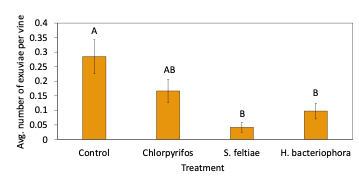
The four management treatments were evaluated by counting the number of exuviae (pupal cases) present on the soil surface under each of the vines in each plot on a weekly basis during both years. During the 2021 season, the number of observed exuviae per plot, there were considerable differences among the treatments. Only the H. bacteriophera treated vines had significantly fewer exuviae than the control vines, whereas the chlorpyrifos and S. feltiae treated vines had marginally fewer exuviae than the control vines. During the second season, in 2022, both H. bacteriophera and S. feltiae treated vines had significantly fewer exuviae than the control vines (Figure 6). These results demonstrate that entomopathogenic nematodes may reduce grape root borer infestation, potentially better than chlorpyrifos. However, as with the insecticides, it is likely that the nematodes will need to be applied on an annual basis.
Conclusions
Growing grapes in the Southeastern US is highly challenging due to the region’s warm, humid climate, which favors both vigorous vine growth and severe pressure from insect pests and diseases. Among the most damaging pests is the grape root borer, a covert, underground insect whose larvae feed on the roots for up to nearly two years, reducing vine vigor, fruit quality, and yields. Although the loss of chlorpyrifos as a widely available management tool seems like a major blow to effective management options, alternative insecticides, mating disruption technologies, and entomopathogenic nematodes have proven to be encouraging management options. Results suggest that while these approaches can suppress grape root borer populations, consistent annual management and integrated strategies are likely necessary for effective long-term control in Southeastern vineyards. There is no silver bullet for grape root borer and each strategy has its limitations, so for up to date management options please refer to the Southern Region Small Fruits Consortium.
References
All, J., M. Saunders, J. Dutcher, and A. Javid. 1981. Susceptibility of grape root borer larvae, Vitacea polistiformis (Lepidoptera: Sesiidae) to Neoaplectana carpocapsae (Nematoda: Rhabditida): Potential of host kairomones for enhancement of nematode activity in grape vineyards, pp. 9, Tree Fruit and Nut Pest Management in the Southeastern United States, vol. 12. BioOne.
Dutcher, J. D., and J. N. All. 1979. Damage impact of larval feeding by the grape root borer in a commercial Concord grape vineyard. Journal of Economic Entomology 72: 159-161.
Pfeiffer, D., C. Luab, T. Jordan, A. Wallingford, and M. Cassell. Year. Published. Control of grape root borer using mating disruption–2009, pp. 35-36. In, Proceedings, 85th Cumberland-Shenandoah Fruit Workers Conference, November 19-20, 2009. 2010, Winchester, VA.
Rijal, J. P., and J. C. Bergh. 2017. Grape Root Borer (Lepidoptera: Sesiidae): An Economic Pest of Commercial Vineyards in the Eastern United States. Journal of Integrated Pest Management 8.
Said, R., R. L. Hix, and S. Reitz. 2015. Biological Control of Grape Root Borer (Lepidoptera: Sesiidae) with Commercially Available Entomopathogenic Nematodes in Florida Muscadine and ‘Cynthiana’ Grapes. Journal of Entomological Science 50: 150-156, 157.
Shapiro-Ilan, D. I., T. C. Leskey, and S. E. Wright. 2011. Virulence of entomopathogenic nematodes to plum curculio, Conotrachelus nenuphar: Effects of strain, temperature, and soil type. Journal of Nematology 43: 187.
Williams, R. N., D. S. Fickle, P. S. Grewal, and J. R. Meyer. 2002. Assessing the Potential of Entomopathogenic Nematodes to Control the Grape Root Borer Vitacea polistiformis (Lepidoptera: Sesiidae) Through Laboratory and Greenhouse Bioassays. Biocontrol Science and Technology 12: 35-42.