Lorena Lopez, North Carolina State University Department of Entomology and Plant Pathology
Growers across the Southeast are increasingly interested in integrating predatory mites into blackberry and raspberry pest management, especially those using high-tunnel systems and organic or reduced-spray programs. As reliance on broad-spectrum pesticides can often result in pest resurgence or outbreaks, and loss of natural enemies and pollinators, biological control agents are becoming more important for suppressing twospotted spider mite (Tetranychus urticae, TSSM, Acari: Tetranychidae), broad mite (Polyphagotarsonemus latus, Acari: Tarsonemidae, Fig. 1-2), and eriophyid mite pests, such as Phyllocoptes gracilis and P. parviflora (Acari: Eriophyidae). Although chemical control remains a major component of integrated pest management (IPM), research in Mexico, Poland, Canada, Norway, and the United States, among other caneberry producer countries, demonstrates that biological control with predatory mites can regulate pest mite populations when introduced early and protected from disruptive pesticide applications.
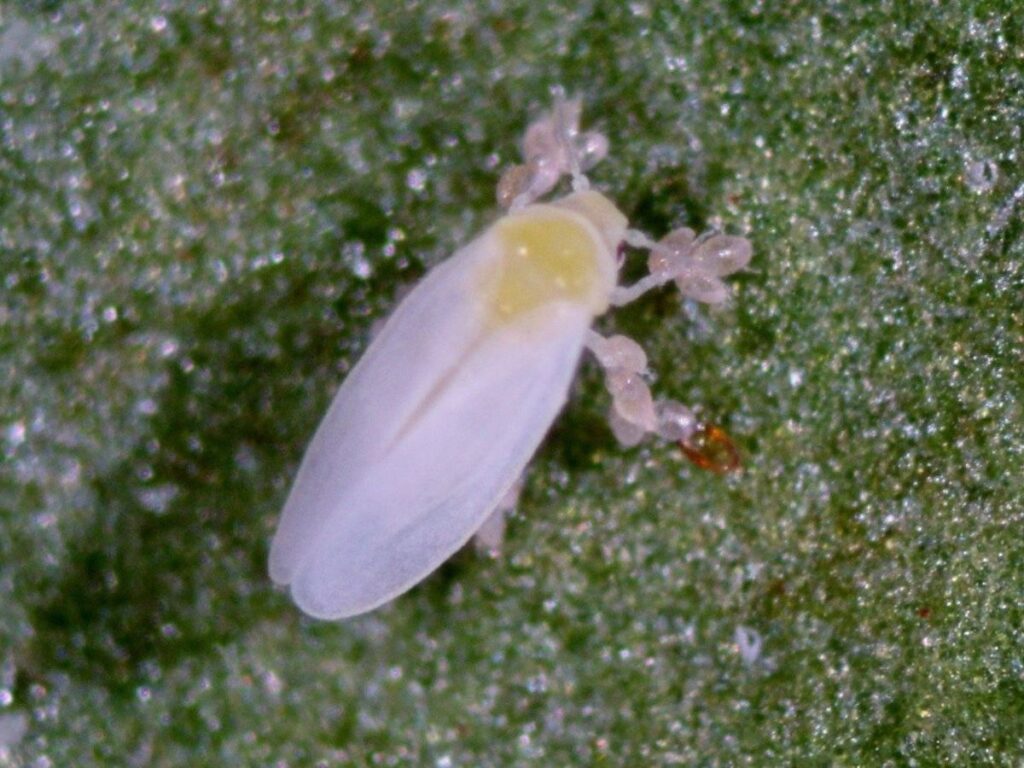
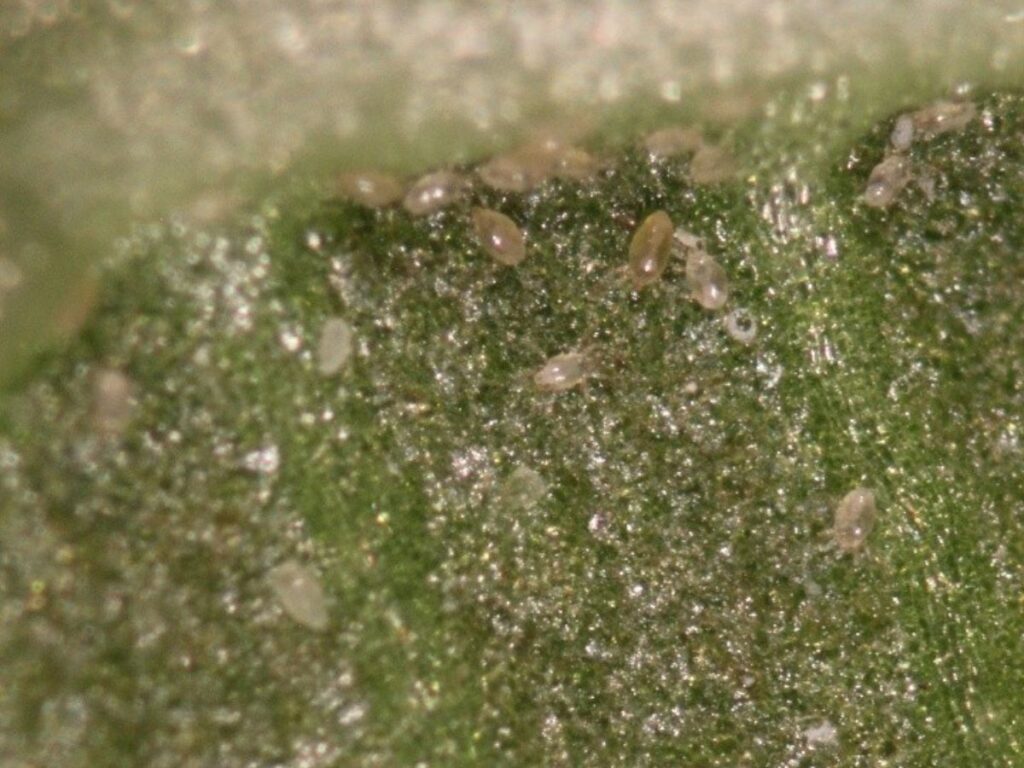
In open-field caneberry systems, one predatory mite species consistently emerges naturally as a valuable predator, Neoseiulus fallacis. In commercial raspberry fields in Washington State, N. fallacis populations track spider mite development closely, showing strong numerical and spatial responses to TSSM. Similarly, in Quebec (Canada), N. fallacis established early in spring and remained synchronized with TSSM populations throughout the season, feeding continuously on TSSM populations even when densities were low. Its ability to persist when prey are scarce is attributed to its capacity to feed on pollen and alternate food sources, making it particularly suitable for early establishment in open field caneberries, especially those where selective pesticide use allows conservation biological control.
Neoseiulus californicus, by contrast, is better adapted to hotter, protected plantings like high tunnels and regions with mixed mite complexes. In organic and conventional blackberry orchards in Michoacán, Mexico, N. californicus was among the dominant predatory mites found consistently across production systems, co-occurring with TSSM and eriophyid species. Moreover, in Arkansas blackberry research, N. californicus and Neoseiulus cucumeris suppressed broad mites, and their performance overlapped favorably with selective acaricide programs. Because N. californicus tolerates higher temperatures and feeds on multiple pest mite groups, it is particularly important for high-tunnels and farms experiencing chronic broad mite injury. This predatory mite is commercially available and can be used for augmentative releases when multiple pests are present, and studies have demonstrated that it can remain in the fields for 6-8 weeks after a single release.
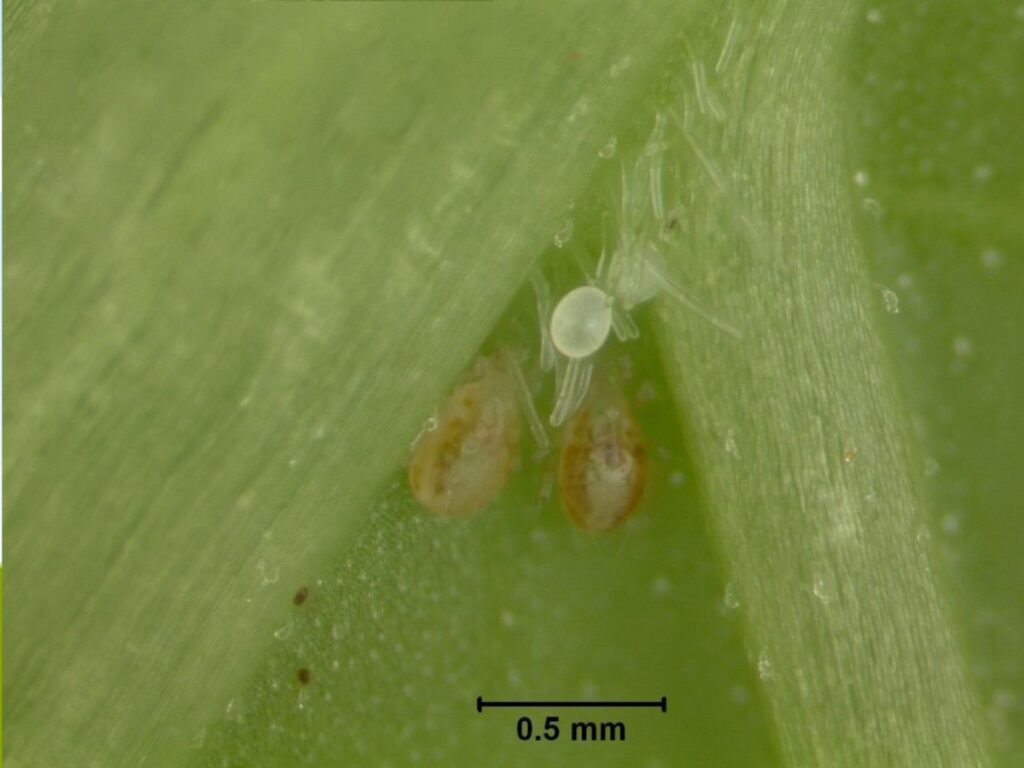
Phytoseiulus persimilis, is an obligatory feeder on spider mites (Tetranychidae) unlike the Neoseiulus species mentioned above, meaning they will not feed on other mite groups, insects, or pollen. Although highly efficient against TSSM, P. persimilis may perform poorly unless TSSM densities are already moderate to high, and it cannot sustain itself without abundant prey. For this reason, P. persimilis have shown mixed performance results. It has demonstrated successful management of spider mites in greenhouse raspberries for at least six weeks following release, but its effectiveness was inconsistent in open fields or when pest densities were low, in both raspberries and blackberries. Field studies demonstrate that timing of releases is more critical than quantity. Generalist predatory mites (Fig. 3) must be present before populations spike. Delayed introductions reduce their impact because TSSM can surpass economic thresholds before predators become established. For instance, late-season build-up of N. fallacis did not prevent early-season injury because densities increased too slowly to suppress pests already established on fruiting canes. Preventative or early-season augmentative releases using generalist predators are therefore recommended, especially in tunnels where rapid TSSM reproduction occurs due to high temperatures and reduced rainfall interference.
Integrating predatory mites with miticides requires careful selection of compatible products. Historical reliance on pyrethroids, organophosphates, and other broad-spectrum miticides reduced predatory mite abundance and triggered pest mite resurgence. Conversely, selective miticides, some oils, and concentrated soaps suppressed pest numbers without fully collapsing predator populations. In blackberry trials targeting broad mites, selective miticides, such as abamectin, could be followed by re-release of predators, which continued suppression effectively. It is usually recommended to apply a miticide during a mite pest outbreak to knock down the population, then release predatory mites to keep the pest population under economic thresholds. When predatory mites are applied after miticide applications, it is recommended to wait 5-7 days before releasing predatory mites to minimize potential harm to the predators.
Together, these findings indicate that the success of predatory mites in caneberries depends on species selection matched to production system, early establishment, and conservation through selective pesticide programs. Outdoor growers benefit most from conserving N. fallacis as a resident predator, whereas tunnel growers and those facing broad mite infestations require N. californicus alongside strategic use of selective acaricides. Preventative releases are effective when predators can survive on pollen or background prey, while corrective releases are best supported by specialists like P. persimilis when spider mites are already abundant.
Neoseiulus californicus can be vulnerable to certain fungicides, especially older broad-spectrum modes of action, such as fungicides belonging to mitochondrial complex I inhibitors (METI-fungicides, most in FRAC 11). Newer chemistries like succinate dehydrogenase inhibitors (SDHI) have been reported to be harmful to Typhlodromus pyri, another predatory mite species, but their effects on the predatory mites mentioned above remain unknown. It is important to note that the susceptibility to pesticides varies among predatory mite species, and some studies consider N. fallacis highly susceptible to various pesticide groups. When using spray programs in caneberry crops, avoiding or minimizing use of fungicide groups reported as harmful to predatory mites and selecting more selective options can help protect these beneficial mites and maintain natural-enemy populations.
In the Southeast, where high tunnel use is expanding and both TSSM and broad mites are increasingly reported in blackberries, an integrated approach using early releases of N. californicus, conservation of N. fallacis outdoors, and careful consideration of miticide compatibility offers the most sustainable path forward. P. persimilis is recommended only when moderate to heavy infestations of TSSM are present and can be mixed with N. californicus for extended control. This approach not only reduces chemical inputs but also builds biological resilience, improving long-term suppression of pest mites while protecting crop yield and quality.