Amanda Lay-Walters, Amanda McWhirt, University of Arkansas; Jayesh Samtani, Virginia Tech; Gina Fernandez, John Havlin, North Carolina State University; Karen Blaedow, Extension Agent, NC Cooperative Extension; Elina Coneva, Auburn University; Eric Stafne, Mississippi State University; David Lockwood, Natalie Bumgarner, University of Tennessee; and Zilfina Rubio Ames, University of Georgia
Regional Survey
Leaf tissue nutrient sampling is an important tool for monitoring blackberry nutrient status. Leaf tissue nutrient samples must be collected from the correct type of leaf and at the correct time in order to accurately compare results to established ranges. A poorly collected sample will lead to a poor interpretation for the farm’s fertility program.
Blackberry leaf tissue nutrient sampling has historically only been recommended during the post-harvest period. This sampling timing only allows growers to make changes to the following season’s fertilizer program. For the blackberry crop, most of the nutrients applied in-season support primocane growth, while floricanes grow on stored nutrients. This means that growers can be a year behind if they determine too late in the season that their fertility management was insufficient. Thus, there is an interest in developing earlier leaf tissue nutrient sampling timings for blackberry in the Southeast.
Seven universities worked together in 2022 and 2023 to survey blackberry leaf tissue nutrients throughout the season (Lay-Walters et al. 2025). Samples were collected in nine locations across the southeastern US, in Alabama, Arkansas, Georgia, Mississippi, North Carolina, Tennessee, and Virginia. Blackberries were sampled at four growth stages during the season. Twelve varieties representative of those grown in the region (Caddo, Chickasaw, Kiowa, Natchez, Osage, Ouachita, Ponca, Prime-Ark® 45, Prime-Ark® Freedom, Prime-Ark® Traveler, Sweetie Pie, and Von) were included. This regionwide collaborative effort was funded by the Southern Region Small Fruit Consortium.
Leaf tissue nutrient concentrations are variable throughout the season, depending on growth stage, and our results from two years of surveying reflect that. Below are the average primocane leaf tissue nutrient concentrations found in southeastern blackberries at the four stages at which samples were collected (Table 1). Notice how concentrations of certain nutrients fluctuate throughout the season while others remain very static over time. Nitrogen, for instance, decreased dramatically from primocanes at 6-12” tall (3.54%) to post-harvest (2.18%). For this reason, it is important for growers to record the growth stage at the time of sampling in order to accurately compare results to the corresponding nutrient sufficiency range for that growth stage. If you used the post-harvest N range on samples collected when primocanes were 6-12” tall, you would most likely determine that your blackberries are very well fertilized when in fact they may be low in nitrogen.
Table 1: Average leaf tissue nutrient concentrations from mature blackberry plantings in the Southeast at four growth stages during the 2022 and 2023 seasons.*
| Primocane 6-12″ Tall | Small, Green Fruit on Floricane | Peak Floricane Harvest | Post-Harvest | |
|---|---|---|---|---|
| N (%) | 3.54 | 3.25 | 2.40 | 2.18 |
| P (%) | 0.34 | 0.30 | 0.22 | 0.21 |
| K (%) | 1.49 | 1.52 | 1.33 | 1.23 |
| Ca (%) | 0.47 | 0.52 | 0.68 | 0.77 |
| Mg (%) | 0.33 | 0.37 | 0.38 | 0.41 |
| S (%) | 0.21 | 0.20 | 0.16 | 0.16 |
| Fe (ppm) | 71.78 | 53.57 | 50.40 | 45.57 |
| Mn (ppm) | 277.04 | 250.29 | 253.33 | 342.88 |
| Zn (ppm) | 39.87 | 43.35 | 32.42 | 33.92 |
| Cu (ppm) | 10.62 | 9.27 | 8.36 | 9.09 |
| B (ppm) | 17.25 | 20.95 | 28.53 | 31.76 |
Minor differences in leaf tissue nutrient concentrations between the states where samples were collected were observed but were attributed to different cultural practices or soil types. Generally, despite these differences, nutrient concentrations all fell within what researchers considered normal ranges. Thus, we do not recommend individual nutrient ranges by state.
One important result of this trial was the determination that the amount of variability in leaf tissue nutrient concentration at each growth stage was similar throughout the season. This will enable the team of researchers to develop new nutrient ranges for earlier season growth stages.
From this regional collaboration, new nutrient sampling times have been identified, and new sufficiency ranges for the three in-season growth stages will be released in a factsheet for the 2026 season through the University of Arkansas System Division of Agriculture Cooperative Extension. Additionally, the ranges recommended for post-harvest in the southeastern US will be updated based on this research. These sufficiency ranges will be applicable for the most recently mature leaves (MRML) of primocanes for both primocane- and floricane-fruiting blackberries.
Leaf Nutrient Sampling
Similar to comparing leaf tissue nutrient results to the correct stage, it is important for growers to familiarize themselves with the correct leaf sampling practices. Older and younger leaves differ in nutrient concentrations and if the wrong leaf age is used in sampling, the result will incorrectly represent plant nutrient status compared to the current ranges. Leaf tissue nutrient samples should be collected according to the following recommendations for blackberry leaf tissue nutrient sampling:
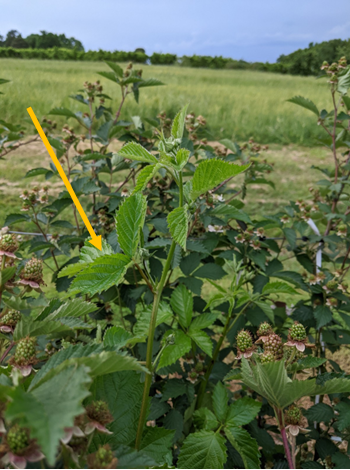
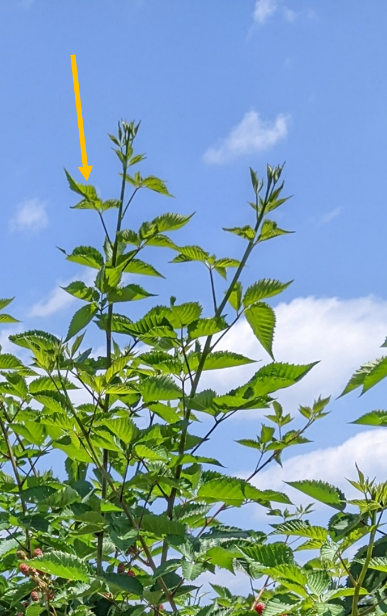
- Collect MRMLs, without the petioles, from primocanes. The MRML is typically the third or fourth fully expanded leaf back from the growing point (Figure 1).
- At least 25–30 leaves per sample should be collected from different plants that uniformly represent the entire field. For larger fields, collect up to 50 leaves.
- Leaves should be stored in paper bags.
- The location, date of sampling, and growth stage should be recorded.
- Store samples in a cool, dry place,
- Avoid collecting leaf samples within 3-4 days after fertilizer or pesticide applications.
Check out Blackberry Plant Tissue Nutrient Sampling on the UAEX YouTube channel for a step-by-step video on how to collect leaf tissue nutrient samples :
Sampling primocane leaves gives the most accurate results of what is currently going on in the plant and continues to be the recommended method. Floricane leaves were sampled, and researchers saw that their results rarely reflected the efficacy of current fertilizer applications. At this time, it is not recommended to collect leaf tissue nutrient samples from floricane leaves.
Timing of Sampling
MRMLs of primocanes can be sampled at four growth stages during the season (Figure 2):
- Primocanes between 6-12” tall
- Small, green fruit on the floricane
- Peak floricane harvest
- Floricanes at post-harvest
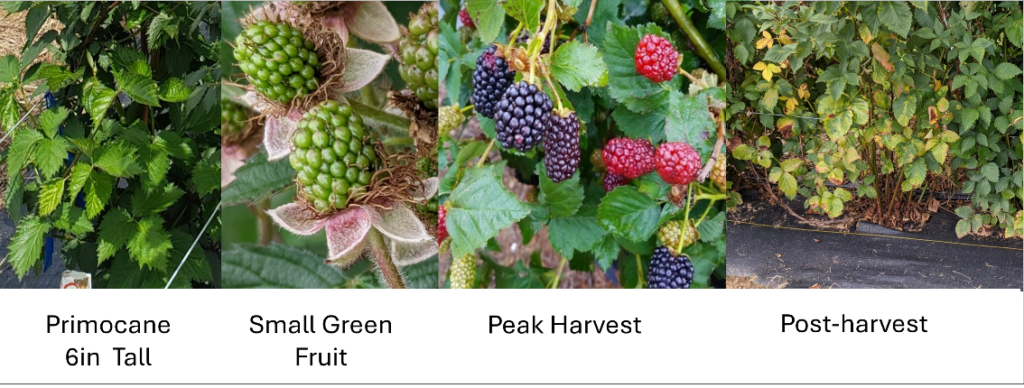
Growth stage terminology is based on the whole plant, however leaf samples should only be collected from primocanes at all stages. For Stage 4, the word floricanes is included to distinguish this post-harvest period from the one that follows the harvest of primocane-borne fruit on primocane-fruiting varieties.
How to Split Samples
It is recommended that growers split the farm into separate samples to account for factors such as soil type, topography, soil drainage, age of planting, and irrigation sources.
Previous recommendations advised to separate samples by variety and fruiting-type. However, in this study differences in nutrient concentrations between varieties were minor and fell within what researchers considered normal ranges. We recommend sampling based on geographic factors (different fields or farms) as the priority without further splitting samples by variety or fruiting-type. However, if varieties with the same geographic factors are at different growth stages when sampled, those samples should not be combined. As new varieties are introduced and cultivated, these results may need to be re-evaluated.
General Recommendations on Results of Leaf Tissue Nutrient Samples
Growers should use leaf tissue nutrient sampling and their own observations of their farms in tandem with regional fertilizer recommendations to tailor fertilizer rates for their farms. When possible, a recent soil nutrient report should be on-hand while reviewing your leaf tissue nutrient results. Generally, plantings in which leaf tissue nutrient concentrations are found to be below the recommended sufficiency ranges may require a higher rate of that nutrient. Where nutrients levels are in excess of the sufficiency ranges, lower rates of those nutrients may be needed. Seek assistance from your local county Cooperative Extension office when making decisions about how to amend your fertility program. Be on the lookout as new sufficiency ranges for these stages will be published through the University of Arkansas Cooperative Extension in the next few months.
References
Lay-Walters AM, Samtani J, Fernandez GE, Havlin J, Coneva E, Stafne E, Bumgarner N, Lockwood D, Ames ZR, Blaedow K, McWhirt AL. 2025. Survey of seasonal variation of leaf tissue nutrient concentration of southeastern blackberry. HortScience 60(11):1928-1937. DOI: 10.21273/HORTSCI18867-25